
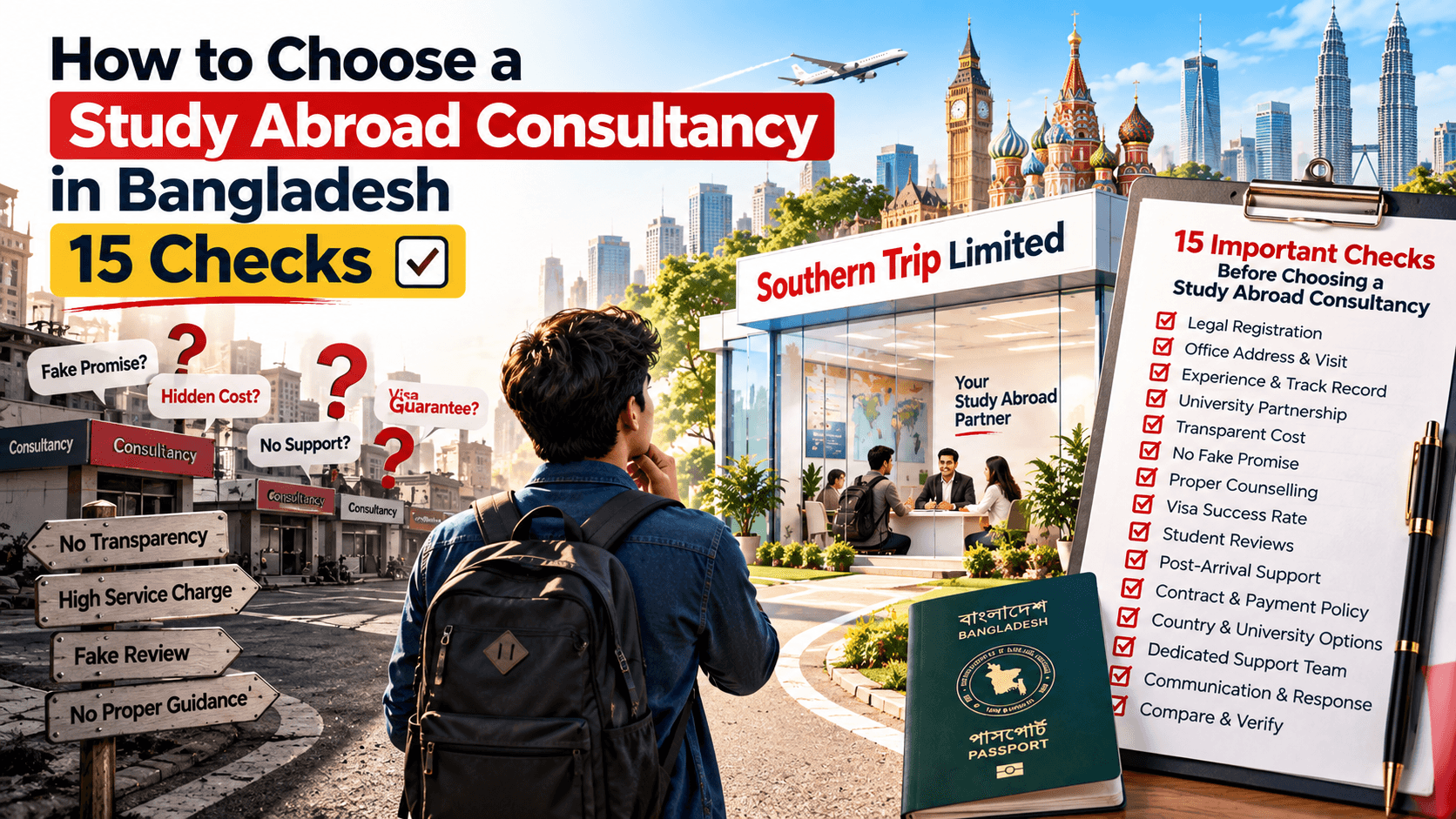
Use these 15 checks to compare study abroad consultancies in Bangladesh: registration, partnerships, fees, refunds, transparency and red flags to avoid before you pay.
Choosing the right study abroad consultancy in Bangladesh can save you time, money and stress, while the wrong choice can cost you a year or more. There are many agencies in Dhaka and across the country. According to a 2026 report in The Business Standard, Bangladesh currently has no dedicated regulator for education consultancies, and many operate with a general trade licence. That makes it even more important for students and guardians to check an agency carefully before paying anything.
This guide gives you 15 practical checks to compare consultancies fairly, questions to ask in your first meeting, the warning signs of a bad agent, and what a good consultancy should and should not do for you.
Key Takeaways
Check legal registration, a physical office and a verifiable track record before paying.
Ask which universities the agency represents, and confirm with the universities directly.
Get every fee, service and refund term in a written agreement.
Avoid any agency that guarantees admission, scholarships or visas, or offers to arrange fake documents or bank balances.
A good consultant gives honest, country-neutral advice based on your profile and budget, and lets you see your own application and university communications.
What Does a Study Abroad Consultancy Do?
A study abroad consultancy (also called an education agent or overseas education consultant) helps you choose a country, university and course, prepare your application and documents, and plan your visa and pre-departure steps. Many are paid commission by partner universities, and some also charge students a service fee.
You can apply to most universities directly without an agent. A consultancy is useful if it saves you time, helps you avoid mistakes and gives honest guidance. It should never replace your own understanding of the process. Our step-by-step university application guide explains what the process involves, so you can judge whether an agent's advice makes sense.
15 Checks Before You Choose a Consultancy
1. Legal Registration
Ask for the agency's trade licence and, if it is a limited company, its company registration with the Registrar of Joint Stock Companies and Firms (RJSC). Check that the name on the documents matches the name on the agreement and receipts.
2. A Real, Visitable Office
Visit the office in person, with a guardian if possible. A stable, physical office with staff and a clear address is a basic sign of accountability. Be careful with agents who operate only through Facebook pages or messaging apps.
3. Official University Partnerships
Ask which universities the agency officially represents. Many universities publish a list of their approved agents or will confirm this by email. The British Council advises students to contact their chosen institution for its list of partner agents.
4. Trained and Certified Counsellors
Ask whether counsellors have completed recognised training. For the UK, the British Council says agents and counsellors should complete its UK certified counsellor training, and you can search its database of certified counsellors. For Australia, Study Australia refers students to the Qualified Education Agent Counsellor (QEAC) list. Training does not guarantee quality, but it shows commitment to professional standards.
5. Country Expertise That Matches Your Goals
Choose an agency with real, current experience in the countries you are considering. Ask specific questions about entry requirements, costs and the visa process. Compare the answers with official sources, such as university websites and visa authorities.
6. Honest, Profile-Based Advice
A good consultant starts by assessing your academic results, English level, budget and goals, then suggests realistic options. Be careful if an agent pushes one country or university without explaining why it suits you. Study Australia recommends asking which providers an agent represents, because some agents work only with certain institutions.
7. Clear, Written Fees
Ask for a full list of fees in writing: consultancy fees, application fees, and any third-party costs, such as translations or courier charges. Study Australia advises comparing service fees between agents, and warns that unusually low or high prices can be a sign of dishonesty.
8. A Written Agreement and Refund Policy
Before paying, get a contract that lists the fees, the exact services included and the refund policy. Read it carefully, especially the conditions for refunds if admission or a visa is refused.
9. No Guarantees
No consultancy can guarantee admission, scholarships or visas, because universities, scholarship bodies and immigration authorities make those decisions. Study Australia states that no agent can guarantee the outcome of a Student visa application. Treat any "100% visa guarantee" as a serious warning sign.
10. Zero Tolerance for Fake Documents
Walk away from any agent who offers fake certificates, fake bank statements, borrowed "show money" or made-up work experience. Fraudulent documents can lead to visa refusal and serious future consequences. Learn how genuine financial evidence works in our financial proof guide.
11. Transparency About Your Application
You should be able to see your application, receive university emails directly, and access your own portal logins. Be cautious if an agent insists on using only their email address, or withholds your offer letters or documents.
12. Payments to Universities Go to Official Channels
Tuition deposits and university fees should normally be paid through the university's official payment methods, not to a personal account. Always get official receipts. Check whether an offer is genuine using our guide to conditional and unconditional offer letters.
13. Verifiable Track Record
Ask for examples of students the agency has helped, and speak to them if possible. Look at reviews across several platforms, not only testimonials on the agency's own page. Be careful with claims about success rates that cannot be verified.
14. Visa and Pre-Departure Support
Ask what support is included after admission: visa document preparation, interview practice, accommodation guidance and pre-departure briefings. For the visa stage, see our student visa interview guide. In some countries, only registered migration agents or lawyers may give immigration advice. Study Australia, for example, notes that only agents on the Register of Migration Agents can give Australian visa advice.
15. Clear Communication and Aftercare
Notice how the agency communicates with you. Do they answer questions clearly, respond on time, and explain risks honestly? Ask how they will keep you updated, and what support they provide after you arrive abroad.
A Simple Way to Compare Two or Three Agencies
Shortlist two or three agencies based on recommendations, office visits and country expertise.
Ask each one the same questions, using the list below, so you can compare answers fairly.
Score each of the 15 checks as yes, no or unclear. Any "no" on checks 9 to 12 (guarantees, fake documents, transparency and payments) should end the discussion.
Compare written quotes, not verbal promises, including what happens to your money if admission or a visa is refused.
Verify key claims independently with universities and official websites.
Decide together with your guardians, without pressure, and keep copies of every agreement and receipt.
Questions to Ask in Your First Meeting
Which universities and countries do you officially represent?
Are your counsellors trained or certified? Which training have they completed?
What exactly is included in your service, and what are all the fees?
What is your refund policy if I do not receive admission or a visa?
Will I have access to my own university portal and emails?
Which options suit my profile and budget, and why?
Can I speak to students you have helped in the past?
Red Flags: When to Walk Away
Guaranteed admission, scholarships or visas
Offers to arrange fake documents or bank balances
Pressure to pay immediately, or "seat is filling up" urgency
No written agreement or official receipts
Payments requested to personal accounts
Refusal to name partner universities, or no physical office
Pushing one country or university without explaining why
Withholding your documents, offer letters or passwords
What a Good Consultancy Will Not Do
A good consultancy will not write your SOP for you, create false documents or answer visa interview questions on your behalf. Your application must be genuine and in your own words. Our guides on writing your own SOP and the study abroad document checklist explain what you need to prepare yourself.
Applying Directly vs Using a Consultancy
Applying directly works well if you are confident with research, deadlines and documents, and can manage visa steps yourself.
Using a consultancy can help if you need guidance on choosing countries and universities, organising documents or preparing for visas, or if your family wants a local point of contact.
Whichever route you choose, use official university and government websites as your final source of truth.
Frequently Asked Questions
How do I know if a study abroad consultancy in Bangladesh is genuine?
Check its trade licence and company registration, visit its office, confirm its university partnerships with the universities directly, and get a written agreement with clear fees and refund terms.
Is there a government licence for education consultancies in Bangladesh?
According to a 2026 report in The Business Standard, there is currently no dedicated regulator, and most agencies operate with a general trade licence or company registration. Always check official sources for any new rules.
Do I have to pay a study abroad consultancy?
It depends on the agency. Many receive commission from partner universities, and some also charge students service fees. Ask for every fee in writing before you agree.
Can a consultancy guarantee my student visa?
No. Visa decisions are made by immigration authorities. An agent who guarantees a visa is a red flag.
Can I apply to foreign universities without a consultant?
Yes. Most universities accept direct applications. A consultancy is optional and should add value through guidance, organisation and honest advice.
How can I check if a counsellor is trained for the UK?
Search the British Council's database of certified counsellors, and ask your chosen UK university whether the agency is an approved partner.
What should I do if an agent asks for fake documents?
Refuse and stop working with that agent. Submitting false documents can lead to visa refusal and long-term consequences.
Compare Us Against These 15 Checks: Southern Trip Limited
We believe students should choose a consultancy with care. Southern Trip Limited supports Bangladeshi students with honest, profile-based guidance, university and course selection, application support and visa preparation for Russia, Malaysia, China, South Korea and the UK. Use this checklist when you meet us, too, and ask us any of the questions above.
Admission, scholarship and visa decisions are made by universities, scholarship bodies and immigration authorities, so no consultancy can guarantee them. Learn about our student counselling service, get your profile assessed or book a free counselling session.
Information in this article was checked in September 2026 against official British Council, Study Australia and published sources, and may change. Always verify details with universities and official authorities.
Planning to Study Abroad?
Speak with our team to compare your options and choose the right next step.