
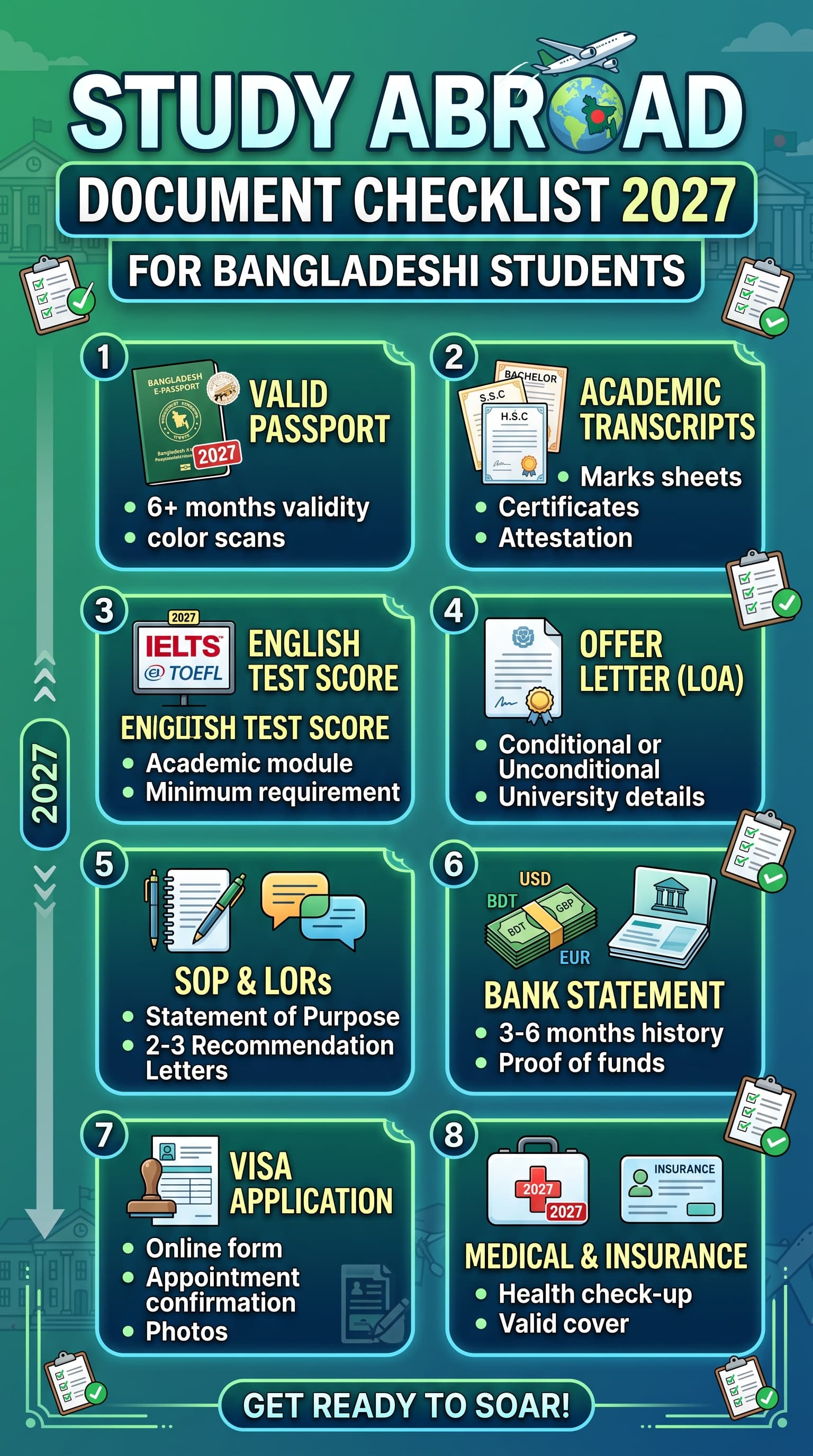
A complete 2027 study abroad document checklist for Bangladeshi students: identity, academic and attestation, English tests, SOP, financial proof, visa documents by country, health and police certificates, and travel.
This study abroad document checklist is written for Bangladeshi students and guardians planning a 2027 intake. It covers every stage, from university applications to visa and travel. It is organised by stage so you can prepare the right documents at the right time and avoid the mistakes that most often delay applications.
Requirements differ by country, university and visa type, so always confirm the latest official checklist for your destination. Use this guide as your master list and then tick off what your specific university and embassy ask for.
Quick Checklist: Core Documents Most Students Need
Valid passport
SSC, HSC and (if applicable) bachelor's and master's certificates and transcripts
Attested copies of academic documents, where required
English test result or other accepted English evidence
Statement of Purpose, CV and recommendation letters
Offer or admission letter from the university
Financial documents (bank statements, sponsor letter, income proof)
Visa-specific documents, such as a CAS, e-VAL, admission notice or invitation
Medical or TB test and police clearance, where required
Passport-size photos that meet each authority's specifications
Key Takeaways
Prepare documents in three stages: application, visa and travel.
Names, dates of birth and other details must match exactly across your passport and certificates.
Bangladeshi board and university certificates often need attestation by the issuing body and the Ministry of Foreign Affairs.
Financial documents must be genuine, consistent and meet each country's timing rules.
Some documents expire, such as English test results, TB certificates and police clearance. Time them carefully.
1. Identity Documents
Passport: Apply or renew early through the official Bangladesh e-Passport portal. Check how long your passport must stay valid for your destination and course length.
Birth certificate and National ID: These may be needed for some visas or to prove family relationships for sponsorship.
Photographs: Each university or embassy may have its own size and background rules.
Check that the spelling of your name, your parents' names and your date of birth are identical on your passport, certificates and NID. Fix any mismatch before you apply.
2. Academic Documents
SSC and HSC (or equivalent) certificates and mark sheets
Bachelor's and master's certificates and full transcripts, for postgraduate applicants
A provisional certificate, if your final certificate has not been issued yet
A Medium of Instruction (MOI) letter, if the university accepts it
Attestation, Translation and Legalisation
Education certificates from a Bangladeshi board or university usually need prior attestation by the issuing board or university and by the Ministry of Foreign Affairs.
Some countries ask for more. For example, the official Study in Russia portal notes that foreign documents need legalisation or an apostille and a notarised Russian translation. The Korean Embassy in Dhaka asks for education records attested by Bangladesh's Ministry of Education and Ministry of Foreign Affairs.
3. English and Language Test Documents
IELTS, PTE, TOEFL or another accepted test result
A language certificate for local-language programmes, such as HSK or TOPIK, where required
Test results expire. According to UK government guidance, SELT results are valid for two years. If you do not have IELTS, see our guide on English test alternatives.
4. Application Documents
Statement of Purpose (SOP) or personal statement, tailored to each programme
CV, especially for postgraduate study or if you have work experience
Recommendation letters from teachers or employers
Research proposal, for research degrees
Portfolio, for creative subjects
Work experience letters and a gap explanation, if relevant
Our step-by-step guide on how to apply to foreign universities explains how to prepare these.
5. Financial Documents
Bank statements for the period required by the destination
A bank solvency certificate, where requested
A sponsor's letter and proof of relationship, such as a birth certificate
Sponsor income proof, such as salary certificates, tax return acknowledgements or business documents
A scholarship award letter, if you have funding
Each country sets its own rules:
UK: You must show the required funds for at least 28 consecutive days, and the period must end within 31 days of applying.
South Korea: The Korean Embassy in Dhaka lists six months of bank statements and tax return proof for D-2 applicants.
Make sure balances, names and figures match across all documents.
6. Visa-Stage Documents by Country
UK
A Confirmation of Acceptance for Studies (CAS) from your university
Proof of funds
An ATAS certificate, if your course requires it
A TB test certificate. Applicants who have lived in Bangladesh and are coming for six months or more need a TB test from an approved clinic. The certificate is valid for six months.
Malaysia
Your university submits the Student Pass application through EMGS using your passport, photo, academic documents and offer letter. You receive an e-VAL before travel and complete medical screening after arrival. See our Malaysia student visa guide.
China
For an X1 visa, official guidance lists the original and a photocopy of the admission notice and the JW201 or JW202 form. After arrival, you must get a residence permit within 30 days.
Russia
You need a study visa invitation arranged through your university, plus legalised or apostilled documents with notarised Russian translations. See our Russia student visa file checklist.
South Korea
For a D-2 visa, the Korean Embassy in Dhaka lists the following, among others:
Certificate of admission
Attested education records
Bank statements and tax return proof
Police clearance and TB test
Family documents and parents' no-objection letter
An English test taken within two years
7. Health and Police Documents
Police clearance certificate: Apply through the official Bangladesh Police clearance portal if your destination or university requires it.
Medical and TB tests: Only from clinics or hospitals the destination accepts.
Vaccination or health records: If requested by the university or destination.
Watch the validity dates. Several authorities only accept certificates issued within a recent period.
8. Pre-Departure Documents
Visa or entry approval
Air ticket and travel itinerary
Accommodation confirmation
Health insurance, if required
University contact details and arrival instructions
Originals of key certificates for enrolment
Printed and digital copies of all important documents
How to Organise Your Document File
Keep originals and attested copies in separate labelled folders.
Scan everything clearly in colour and name files consistently (for example, "HSC_Certificate_Name.pdf").
Keep a checklist for each university and visa, and tick off each item.
Use good-quality printing and follow each authority's order and format.
Store backups in secure cloud storage, and keep copies with a family member.
For a Bangla guide with video tips, see our student visa file checklist.
Document Timeline for a 2027 Intake
6–12 months before: Passport, academic certificates, attestation, English test, SOP and recommendation letters.
3–6 months before: Offer letter, financial documents, and scholarship documents if applicable.
1–3 months before: Visa document (CAS, e-VAL, admission notice or invitation), TB or medical test, police clearance, and the visa application.
Final weeks: Tickets, accommodation, insurance and document copies.
Common Document Mistakes
Name or date mismatches between the passport and certificates.
Missing attestation or translation that the country requires.
Bank statements with sudden unexplained deposits or the wrong time period.
Expired English test results, TB certificates or police clearances.
Using an old checklist instead of the latest official one.
Submitting fake or altered documents, which can lead to refusal and future bans.
Frequently Asked Questions
What documents do I need to study abroad from Bangladesh?
Usually a passport, academic certificates and transcripts, an English test result, an SOP, recommendation letters, an offer letter, financial documents and visa-specific documents. Some countries also need medical tests and police clearance.
Where do I attest my educational certificates?
Bangladeshi board and university certificates typically need attestation by the issuing board or university and by the Ministry of Foreign Affairs. Some destinations also require Ministry of Education attestation or legalisation.
How many months of bank statements do I need?
It depends on the country. The UK requires funds held for 28 consecutive days. The Korean Embassy in Dhaka lists six months of statements for D-2 applicants. Check your destination's official rules.
Do I need a police clearance certificate?
Some countries and universities require one, for example South Korea's D-2 visa checklist from Dhaka. Apply through the official Bangladesh Police portal when needed.
Do I need to translate my documents?
Only if the destination requires it. Russia, for example, requires notarised Russian translations of foreign education documents.
Is a TB test required for studying in the UK?
Yes, if you have lived in Bangladesh and are coming to the UK for six months or more. The test must be done at an approved clinic.
When should I start preparing documents?
Ideally 6–12 months before your intake, because passports, attestation and English tests can take time.
Get Your Documents Checked by Southern Trip Limited
A complete, consistent document file saves time and reduces the risk of delays. Southern Trip Limited helps Bangladeshi students prepare and review admission and visa documents for Russia, Malaysia, China, South Korea and the UK, using the latest official checklists.
Admission and visa decisions are made by universities and immigration authorities, so no consultancy can guarantee them. Get your profile assessed or book a free counselling session to review your documents.
Requirements in this article were checked against official sources in September 2026 and may change. Always use the latest checklist from your university and the relevant embassy or immigration authority.
Planning to Study Abroad?
Speak with our team to compare your options and choose the right next step.