
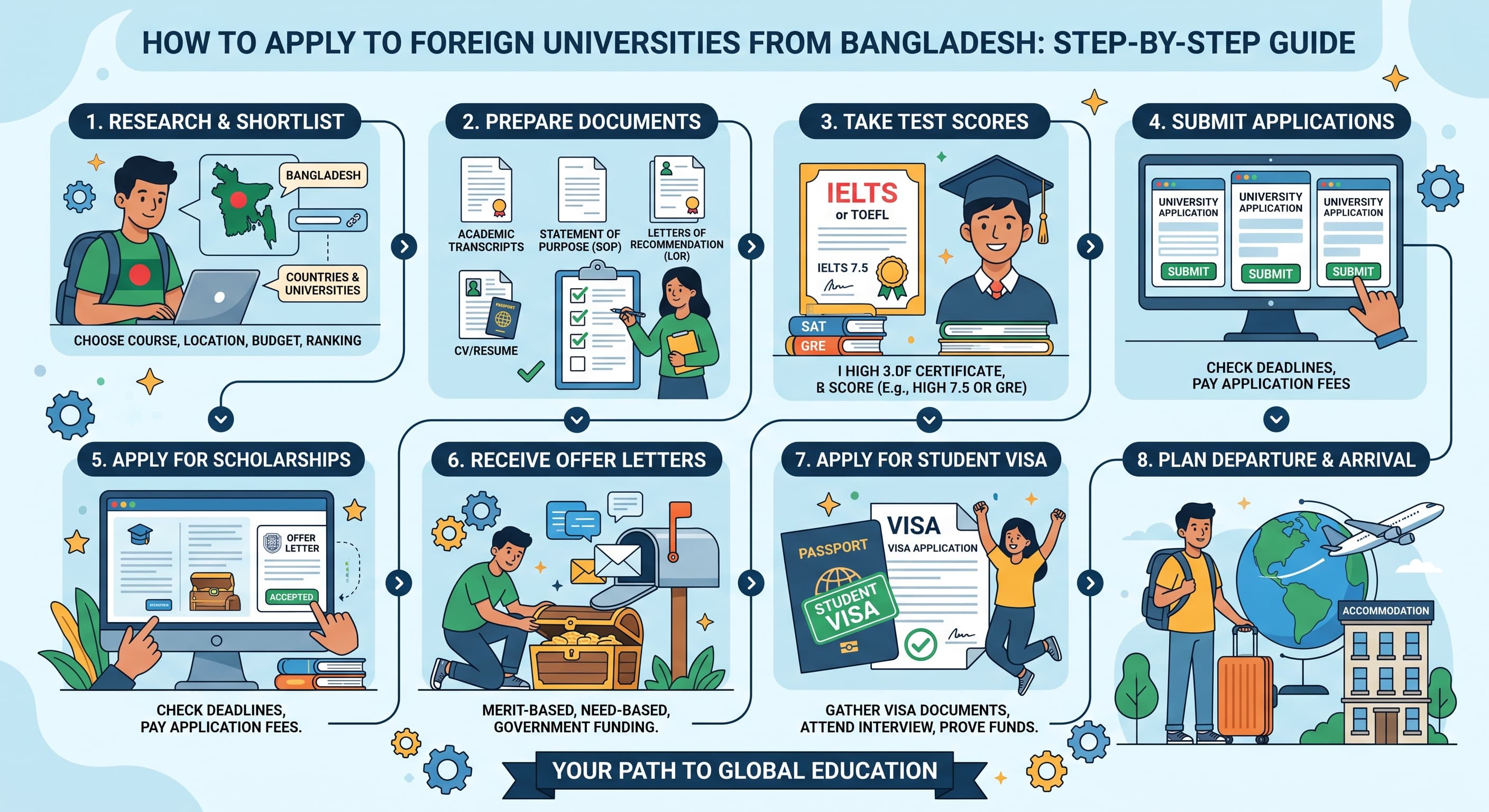
A step-by-step guide for Bangladeshi students applying to foreign universities: shortlisting, entry requirements, documents, SOP, application portals, offers, deposits and the move from offer to student visa.
Wondering how to apply to foreign universities from Bangladesh? The process is similar in most countries:
Shortlist programmes and check entry requirements.
Prepare documents, including your Statement of Purpose and recommendation letters.
Apply through the correct channel, such as UCAS, a university portal or uni-assist.
Respond to your offer, then use your university's confirmation document to apply for a student visa.
The details change by country, level and university.
This guide focuses on the university application itself: what to prepare, where to apply, how offers work, and what happens between an offer and your visa. For the wider journey, including choosing a country and budgeting, see our complete study abroad guide for Bangladeshi students.
Quick Answer: The Application Process in 10 Steps
Decide your level, subject and intake.
Shortlist programmes using official university pages.
Check academic, subject and English requirements.
Prepare and attest your documents.
Write your SOP and collect recommendation letters.
Apply through the right channel before the deadline.
Pay application fees and track your applications.
Attend interviews or tests if required.
Understand, accept and meet the conditions of your offer.
Get your confirmation document and apply for the visa.
Key Takeaways
Always use each university's official entry-requirement page for Bangladeshi applicants.
The application channel depends on the country and level. For example, UK undergraduate applications go through UCAS, while many UK postgraduate applications go directly to the university.
Start 9–12 months before your intake, because some deadlines, especially for scholarships, come very early.
A conditional offer is not a final place. You must meet its conditions first.
Keep your name, dates and details identical across every document.
Step 1: Decide Your Level, Subject and Intake
Be clear about whether you are applying for a Bachelor's, Master's or PhD, which subject you want, and which intake you are targeting. Many countries have a main September or autumn intake, and some also offer other intakes. Your intake determines every deadline that follows.
Our guides for bachelor's study after HSC, master's abroad and PhD abroad explain level-specific rules.
Step 2: Shortlist Programmes Using Official Sources
Use university programme pages, not social media posts, for course content, fees and intakes.
Look for the university's country page for Bangladesh, which often lists HSC and CGPA equivalents.
For Malaysia, check programme accreditation on the Malaysian Qualifications Register.
Aim for 5–8 programmes across realistic, ambitious and safer options.
Not sure which country to choose? Compare options in our guide to the best countries to study abroad from Bangladesh.
Step 3: Check Entry Requirements Carefully
Academic: Minimum HSC result or bachelor's CGPA, and degree length (for example, a 4-year bachelor's for many master's programmes).
Subject: Required HSC subjects or a related undergraduate degree.
English: IELTS or accepted alternatives, with minimum scores.
Other: Portfolio, interview, entrance exam, age limit or work experience.
If you have a low GPA, no IELTS or a study gap, read our guides on studying with a low GPA and IELTS alternatives.
Step 4: Prepare Your Documents
Valid passport (check the name spelling matches your certificates)
SSC, HSC and degree certificates, plus transcripts or mark sheets
Attested copies where required. Bangladeshi board and university certificates usually need attestation by the issuing board or university and the Ministry of Foreign Affairs.
English test result, or other accepted English evidence
Statement of Purpose (SOP) or personal statement
Recommendation letters
CV, especially for postgraduate study
Research proposal, for research degrees
Notarised translations or legalisation, where a country requires them (for example, Russia)
Writing a Strong SOP
Explain why this subject, this university and this country, with specific reasons.
Connect your past study or work to the course.
Describe your career plan after graduation.
Address any gap or weak result briefly and honestly.
Follow the word limit and write it yourself. Copied or generic statements weaken your application.
Getting Recommendation Letters
Ask teachers or employers who know your work well. Give them at least three to four weeks, share your CV and target programmes, and check whether the university wants letters uploaded by the referee directly.
Step 5: Apply Through the Right Channel
UK undergraduate: Apply through UCAS. For 2027 entry, the application fee is £34.50 for up to five choices. Key dates are 15 October 2026 (Oxford, Cambridge and most medicine), 13 January 2027 (most courses) and 30 June 2027 (final date).
UK postgraduate: Usually apply directly on each university's website.
Germany: Many universities use uni-assist to check international applications. The handling fee is €75 for the first choice and €30 for each additional choice per semester. Others accept direct applications.
Malaysia: Apply to the university. After you are accepted, the institution submits your Student Pass application through EMGS.
China: Apply through the university's international admissions portal. Chinese Government Scholarship applications use Campus China.
Russia: Apply to the university, or through the official Education in Russia portal for the government quota. See our Russia application guide.
South Korea: Apply to the university directly. GKS scholarship applications follow official embassy or university tracks.
Step 6: Pay Fees, Submit and Track
Pay only through official university or application-system payment pages.
Save every confirmation email, application number and receipt.
Check your portal and email regularly, including spam, for document requests.
Respond to requests quickly. Delays can cost you a place.
Step 7: Interviews and Tests
Some universities hold admission interviews, English checks or entrance exams. Russian universities, for example, may use internal entrance exams. UK universities may also hold pre-visa credibility interviews. Prepare to explain your course choice, career plan and finances clearly.
Step 8: Understand Your Offer
As UCAS explains, the two main types of offer work like this:
Conditional offer: You still need to meet requirements, usually exam results.
Unconditional offer: You have a place, although a few things may still need arranging.
Read every condition, such as final results, an English score, original documents or a deposit, and note the reply deadline.
Step 9: Accept, Pay Any Deposit and Get Your Visa Document
After you accept, the university issues the document you need for your visa. This varies by country:
UK: A Confirmation of Acceptance for Studies (CAS) from your licensed sponsor. It is listed in the documents you must provide.
Malaysia: The EMGS approval (e-VAL), requested by the university.
China: An admission notice and a visa application form issued through the university.
Russia: A study visa invitation arranged through the university.
South Korea: A certificate of admission for the D-2 visa.
Before paying any deposit, read the university's refund policy, especially what happens if your visa is refused.
Step 10: Apply for Your Student Visa
Prepare genuine financial documents, then apply using the latest official checklist. For the UK, the earliest you can apply from outside the UK is six months before your course starts. Our student visa file checklist covers common errors.
Application Timeline for a September 2027 Intake
September–October 2026: Shortlist programmes, book English tests, and start your SOP and recommendation requests. Note early deadlines, such as UCAS on 15 October and several scholarships.
November 2026 – January 2027: Submit most applications. The main UCAS equal consideration date is 13 January 2027.
February – May 2027: Attend interviews, receive and compare offers, and meet conditions.
May – July 2027: Accept an offer, pay any deposit and receive your CAS, e-VAL or admission documents.
June – August 2027: Apply for your visa and prepare to travel.
Scholarship deadlines can be much earlier. Check our guide to scholarships for Bangladeshi students.
Common Application Mistakes
Using unofficial or outdated requirement lists.
Name or date mismatches between the passport and certificates.
Sending the same generic SOP to every university.
Applying only to highly competitive programmes.
Missing document requests or reply deadlines.
Paying deposits without reading the refund policy.
Submitting fake or altered documents, which can lead to refusal or cancellation.
Frequently Asked Questions
How many universities should I apply to?
Many students apply to around five to eight programmes across different levels of competitiveness. UCAS allows up to five choices for UK undergraduate courses.
Can I apply to foreign universities myself without an agent?
Yes. You can apply directly through official portals. A consultancy can help with shortlisting, documents and deadlines, but decisions are made by universities.
When should I start applying for a 2027 intake?
Ideally 9–12 months before your intake. For a September 2027 start, begin shortlisting in September or October 2026.
Can I apply before my final results are published?
Often yes. Many universities make conditional offers based on current or predicted results, which you must confirm later.
Do I need to attest my certificates before applying?
Some universities accept scanned copies at the application stage and ask for attested or original documents later. Visas and some countries require attestation or legalisation, so start early.
What is the difference between a conditional and an unconditional offer?
A conditional offer requires you to meet certain conditions, usually results. An unconditional offer means you have a place, subject to any final arrangements.
How much are application fees?
It varies. UCAS charges £34.50 for 2027 entry, uni-assist charges €75 for the first choice, and many universities set their own fees. Check each official page.
Get Application Support from Southern Trip Limited
A well-organised application saves time, money and stress. Southern Trip Limited helps Bangladeshi students shortlist programmes, prepare and check documents, and review SOPs. We also track deadlines and move from offer to visa for Russia, Malaysia, China, South Korea and the UK.
Admission and visa decisions are made by universities and immigration authorities, so no consultancy can guarantee them. Get your profile assessed or book a free counselling session to start your 2027 applications.
Fees, dates and processes in this article were checked against official sources in September 2026 and may change. Always confirm current details on the official university or application portal.
Planning to Study Abroad?
Speak with our team to compare your options and choose the right next step.