
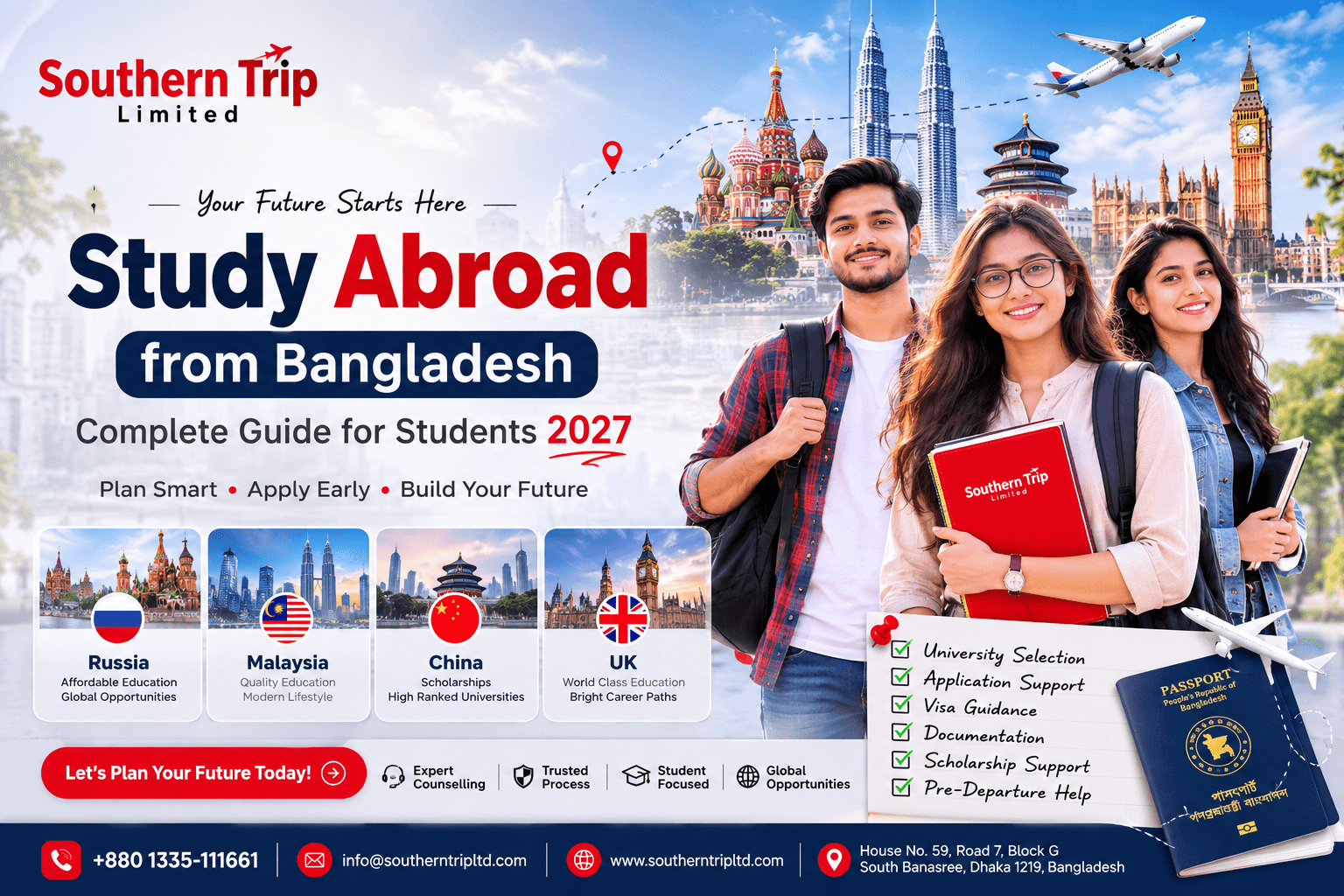
A complete, step-by-step 2027 guide for Bangladeshi students planning to study abroad — covering top destinations, requirements, IELTS, costs, scholarships and the visa process.
Deciding to study abroad is one of the biggest decisions a Bangladeshi student and their family will make. It touches academics, money, distance from home, and an unfamiliar country's rules — often all at the same time. For a first-time applicant, that can feel overwhelming.
The good news is that the process becomes far more manageable once you break it into stages: choosing a country, understanding entry requirements, preparing documents, applying to universities, and finally handling the student visa. Thousands of Bangladeshi students go through this journey every year, and with the right preparation, you can too.
This guide walks through the complete study abroad journey from Bangladesh, written with the 2027 admission cycle in mind. It covers popular destinations, requirements, IELTS, GPA and study-gap concerns, a step-by-step application process, realistic costs, scholarships, and student visa preparation — explained in plain language for students and parents who are just starting to explore their options.
Why Study Abroad from Bangladesh?
Studying abroad is a significant personal and financial commitment, so it helps to be clear about what it can realistically offer.
International academic exposure — learning alongside students from many countries, with different teaching methods and classroom cultures.
A wider choice of programmes — some specialisations and combined degrees are newer or less common in Bangladesh.
Research opportunities — particularly at Master's and PhD level, where labs, supervisors and funding structures may be more developed at certain universities.
An international environment — daily exposure to different cultures, languages and ways of working.
Personal development — independence, budgeting, time management and problem-solving skills that come from living on your own in a new country.
Global professional exposure — a broader professional network and familiarity with international working standards.
It's worth staying realistic too. Studying abroad does not automatically guarantee a job offer, permanent residency or any immigration outcome — those depend on separate rules and your own qualifications and effort. Treat it primarily as an academic and personal-development decision, with any career or migration outcome as a possible future step rather than a promise.
Who Can Apply to Study Abroad?
Bangladeshi students typically consider studying abroad at three stages:
Bachelor's applicants — usually students who have completed, or are completing, HSC or an equivalent Diploma.
Master's applicants — usually students who hold, or are completing, a Bachelor's degree.
PhD applicants — usually students who hold, or are completing, a relevant Master's degree, often with a research interest already in mind.
In Bangladesh, the typical academic progression looks like this:
SSC → HSC / Diploma → Bachelor's → Master's → PhD
Each stage abroad builds on the previous one, but exact entry requirements — minimum GPA, subject background, English test scores and age — differ by country, university and even by individual programme, so they need to be checked at the programme level, not just the country level.
How to Choose the Right Country
With several study destinations to consider, it helps to compare them against your own situation rather than going by popularity alone. Useful factors to weigh include:
Academic profile — your GPA, subject background and English proficiency affect which universities and programmes are realistic.
Preferred programme — not every country or university offers every subject at every level.
Tuition budget — costs vary widely, even within the same country.
Living budget — accommodation, food and daily costs differ by city, not just by country.
Language requirements — some programmes are taught in English, others in the local language, sometimes with a preparatory year.
University options — the number and type of universities available for your programme.
Climate and lifestyle — easy to overlook, but it affects day-to-day comfort and adjustment.
Visa requirements — each country has its own student visa category, documentation and timeline.
Long-term personal goals — whether you're prioritising affordability, research strength, work-while-studying options, or the fastest realistic path to a recognised degree.
There's no single "best" country for every student. The right choice depends on how these factors line up with your own profile and goals.
Popular Study Destinations for Bangladeshi Students
Among the many study destinations available worldwide, Russia, Malaysia, China and the United Kingdom are commonly considered by Bangladeshi students, each for different reasons. Here's a brief, honest look at each.
Study in Russia from Bangladesh
Known for: affordability relative to many Western destinations, strong programmes in engineering, medicine and the sciences, and a large existing community of international students.
Good to know: some universities offer English-taught tracks for certain programmes, while others are taught in Russian with a preparatory year; exact availability varies by university and programme.
For a full breakdown of programmes, universities and admission steps, see our Study in Russia from Bangladesh guide.
Study in Malaysia from Bangladesh
Known for: widespread English-medium instruction, a comparatively moderate cost of living in many cities, and a mix of local and branch-campus international universities.
Good to know: Malaysia is often considered by students looking for an English-taught option with a more moderate overall budget, though this varies by university and city.
See our Study in Malaysia from Bangladesh guide for programme and requirement details.
Study in China from Bangladesh
Known for: modern campuses, a growing number of English-taught programmes at postgraduate level, and government scholarship schemes for international students.
Good to know: many undergraduate programmes are taught in Mandarin, so English-medium availability should always be confirmed at the specific university and programme level.
Learn more in our Study in China from Bangladesh guide.
Study in the UK from Bangladesh
Known for: globally recognised universities, English-medium instruction throughout, and typically shorter degree durations — a three-year Bachelor's and a one-year Master's at many universities.
Good to know: tuition and living costs in the UK generally sit higher than in several other destinations, so early budgeting matters.
Read our Study in the UK from Bangladesh guide for more detail.
None of these destinations is universally "best" — the comparison below can help you narrow things down before you speak with a counsellor.
Russia vs Malaysia vs China vs UK — Quick Comparison
The snapshot below compares the four destinations across a few practical dimensions. Costs are shown only in relative terms, since actual figures vary by university, city and lifestyle.
Study Environment
Russia: Large, established universities with strong traditions in engineering, medicine and the sciences.
Malaysia: A mix of public universities, private universities and international branch campuses.
China: Large, modern campuses with growing investment in international programmes.
UK: Long-established universities with strong global academic recognition.
Language / Medium Considerations
Russia: Mix of English-taught and Russian-taught programmes; some require a preparatory year.
Malaysia: Predominantly English-medium instruction at most institutions.
China: Growing number of English-taught postgraduate programmes; many undergraduate programmes are in Mandarin.
UK: English-medium throughout.
Typical Programme Choices
Russia: Engineering, medicine, technology and natural sciences.
Malaysia: Business, engineering, IT and hospitality, among others.
China: Engineering, business, and an expanding range of postgraduate research programmes.
UK: A very wide range of subjects across nearly all fields.
Cost Position (Relative)
Russia: Generally positioned lower relative to Western destinations, though this varies by university and city.
Malaysia: Generally positioned lower to moderate, with variation by institution and city.
China: Generally moderate, with scholarship options that can lower the effective cost for some students.
UK: Generally positioned higher relative to the other three destinations here.
Best Suited For
Russia: Students prioritising affordability alongside strong STEM or medical programmes.
Malaysia: Students who want English-medium study with a moderate overall budget.
China: Students interested in modern facilities, scholarship opportunities, and growing research programmes.
UK: Students prioritising globally recognised universities and shorter degree durations, with a higher budget available.
These comparisons are general starting points, not fixed rules. Actual costs, language requirements and programme availability vary by university, city and course, and can change over time. Always confirm current details with the university directly or with our counsellors before making a decision.
Study Abroad Requirements for Bangladeshi Students
While specific requirements vary by university, country and programme, most applications ask for a broadly similar set of core documents:
Valid passport
Academic certificates (SSC, HSC/Diploma, Bachelor's or Master's, as relevant to your target programme)
Academic transcripts / mark sheets
Passport-size photographs
Evidence of English-language proficiency, where required by the programme
Statement of Purpose (SOP), where required
Letters of recommendation, where required
CV/Resume, where required (more common for Master's and PhD applications)
Financial documentation, where required for admission or visa purposes
Any other university- or country-specific documents requested during the application
Because requirements differ so much between universities — even within the same country — always confirm the exact document checklist for your specific programme rather than assuming it matches a friend's experience or a general list like this one.
Do You Need IELTS to Study Abroad?
This is one of the most common questions we hear, and the honest answer is: it depends on the university and the programme.
IELTS is a widely accepted way to prove English proficiency, and many universities do require it — especially for English-medium programmes in the UK. However, IELTS is not required everywhere or by every programme. Some universities and countries accept alternative evidence of English proficiency, such as:
Other recognised English tests, where the university accepts them
A prior qualification completed in English medium, in some cases
A university's own English placement or entrance assessment
A preparatory year that includes language training, particularly for some Russian- or Chinese-medium programmes
Requirements vary significantly by country, university, and even by specific programme within the same university. It's never accurate to say "no IELTS required anywhere," and it's equally inaccurate to say IELTS is compulsory for every course. The only reliable approach is to check the English-language requirement listed for your specific target programme.
If you're unsure whether your target programme requires IELTS, our student counselling service can help you check this against real programme requirements before you invest time or money in test preparation.
Can You Study Abroad with a Low GPA?
A lower GPA does not automatically close the door to studying abroad, but it does affect which options are realistic.
Different universities set different minimum GPA or grade requirements, and these vary significantly even within the same country.
Programme choice matters — some subjects and universities are more flexible on academic history than others.
Your overall academic history, not just your most recent result, may be considered by some institutions.
Other profile factors — such as relevant work experience, a strong Statement of Purpose, or specific test scores — can matter for certain programmes, particularly at postgraduate level.
Rather than assuming a low GPA rules out studying abroad entirely, it's more useful to have your academic profile assessed so you can see which countries, universities and programmes are realistic for you specifically — and where a different approach, such as a foundation year where available, might help.
What About a Study Gap?
Having a gap in your education — for example, time between HSC and Bachelor's, or between Bachelor's and Master's — does not automatically mean you cannot study abroad.
That said, a few things are worth keeping in mind:
Acceptance of study gaps varies by university and by country; some are more flexible than others.
Universities may ask for an explanation letter or supporting evidence about what you did during the gap.
Visa authorities in some countries may also take the length and nature of a gap into account when assessing genuine study intent.
A gap of a few months is generally a minor factor, but a longer gap may need a clearer explanation and stronger supporting documents. It is not accurate to say every country accepts unlimited gaps without question, so if you have a significant gap, it's worth discussing your specific situation before choosing a country or university.
Study Abroad Application Process — Step by Step
Profile Assessment — Review your academic background, budget and goals to understand realistic options.
Choose Country — Narrow down destinations based on the factors covered earlier in this guide.
Select Programme — Decide on the subject and degree level (Bachelor's, Master's or PhD) you want to pursue.
Shortlist Universities — Identify a realistic set of universities that offer your chosen programme.
Check Entry Requirements — Confirm the exact GPA, English test and document requirements for each shortlisted programme.
Prepare Documents — Collect, and where needed, get certificates and transcripts translated or attested.
Submit Application — Apply to your chosen universities, following each one's specific process and deadlines.
Receive Admission Decision — Wait for the university's decision, which may include conditional offers.
Complete Required University Procedures — Confirm your seat, pay any required deposit, and complete enrolment formalities as instructed.
Prepare Visa Application — Gather the specific documents your destination country's student visa requires.
Pre-departure Preparation — Arrange travel, accommodation, health insurance where required, and orientation information.
Travel and Begin Studies — Travel to your destination and begin your programme.
Timelines for each step vary by country and university, so it helps to start early and track deadlines carefully rather than leaving steps until the last moment.
How Much Does Studying Abroad Cost?
One of the most common mistakes is looking only at tuition fees and forgetting the rest of the budget. A realistic study abroad budget usually includes:
Application-related costs — university application fees, document attestation, courier and translation costs
Tuition fees — which vary enormously by country, university, city and programme
University deposits — where applicable, to confirm your seat
Visa/application costs — visa fees and related processing charges
Health insurance — where required by the university or destination country
Accommodation — on-campus or off-campus, which varies by city
Food — daily living costs
Transportation — local transport within your city of study
Air ticket — international travel to and from Bangladesh
Initial settlement expenses — items you need in your first weeks, such as bedding, basic supplies and a local SIM card
We're intentionally not listing exact figures here, because tuition and living costs vary by university, city, programme and lifestyle, and they change over time. Build your budget using current figures from your shortlisted universities, and confirm details with our counsellors before making any financial commitment.
Because tuition is often only part of the picture, building a full budget — not just comparing headline tuition fees — is the more reliable way to compare destinations.
Scholarships for Bangladeshi Students
Scholarships can meaningfully reduce the cost of studying abroad, but they are competitive and never guaranteed. Common types include:
University scholarships — offered directly by individual universities, often based on academic merit.
Merit-based scholarships — tied to strong academic results or entrance exam performance.
Government-funded opportunities — scholarship schemes offered by some destination-country governments for international students, subject to their own eligibility rules and yearly availability.
Programme-specific funding — funding tied to a particular course, department or research area.
Research funding — for some postgraduate and PhD programmes, funding or a stipend may be linked to a research position or supervisor.
Eligibility, application windows and outcomes differ every year and by institution, so always confirm details through the official university or government scholarship channel for the year you're applying. We can help you understand which categories may suit your profile and guide you through the application — but we do not guarantee any scholarship outcome, and not every applicant receives funding.
Student Visa Preparation
Every study destination has its own visa category, process and requirements for students, and these are set and decided by that country's immigration or embassy authorities — not by any consultancy. At a general level, strong visa preparation usually involves:
Using the correct, currently valid document checklist for your specific destination and visa category
Making sure the information across all your documents — names, dates, academic details — is consistent
Providing genuine, verifiable financial evidence where the visa category requires it
Being able to clearly explain your genuine study purpose and programme choice
Following the specific embassy or immigration authority's requirements and format exactly
Preparing for a visa interview where one is required, with honest and consistent answers
Visa decisions are made solely by the relevant embassy or immigration authority. No consultancy — including Southern Trip — can guarantee a visa outcome. What we can do is help you prepare a complete, accurate and well-organised application.
Common Study Abroad Mistakes to Avoid
Choosing a country only because friends or relatives chose it, without checking whether it fits your own profile and goals
Selecting universities without carefully checking entry requirements first
Looking only at tuition fees and ignoring living costs and other expenses
Submitting documents with inconsistent names, dates or details across different papers
Waiting until close to the deadline to start preparing documents or applications
Assuming IELTS rules are the same at every university, when requirements actually vary
Believing anyone who promises a guaranteed visa or guaranteed admission
Not researching the actual content and structure of the programme before applying
Not understanding a university's or agency's refund and payment conditions before paying anything
Relying on social media rumours instead of official university or embassy information
When Should You Start Preparing for 2027?
Study abroad applications and visas take time to process, so early preparation gives you more options and less last-minute stress. Depending on your target country and intake, it's generally sensible to begin preparing well ahead of your intended start date. Useful early steps include:
Making sure your passport is valid, or applying for one or renewing it early if needed
Organising your academic documents — certificates, transcripts and mark sheets — in advance
Researching countries and comparing them against your own profile and budget, as covered earlier in this guide
Shortlisting universities and programmes that match your academic background
Starting English test preparation early, if your target programmes require it
Planning your finances and understanding what financial documentation your chosen destination will expect
Noting each university's specific application deadlines, since these differ by country, institution and intake
There is no single universal deadline — intake dates are set individually by each institution, so check them directly for your shortlisted programmes as early as possible.
How Southern Trip Ltd Can Help
Southern Trip Ltd works with Bangladeshi students at every stage of the study abroad journey, including:
Initial profile assessment, to help you understand realistic country and university options
Country and university guidance based on your academic background, budget and goals
Application guidance, including university shortlisting and submission support
Documentation support, to help you prepare and organise required paperwork
Visa preparation guidance, based on the current requirements of your destination country
Pre-departure guidance, so you know what to expect before you travel
You can see the full range of support we offer on our services page. We aim to give you honest, realistic guidance at every step — we do not guarantee admission or visa outcomes, because those decisions are made by universities and immigration authorities, not by us.
Get Your Profile Assessed or book a Free Counselling session with our team.
Final Thoughts
Studying abroad from Bangladesh in 2027 is achievable for many students, but it works best as a planned journey rather than a rushed decision. The right destination is not necessarily the most popular one among your friends or on social media — it's the one that genuinely matches your academic profile, your budget and your long-term goals.
Take the process one stage at a time: understand your options, prepare thoroughly, and ask questions whenever something is unclear.
When you're ready, book a free counselling session or get your profile assessed with Southern Trip Ltd, and take the first real step toward studying abroad in 2027.
Frequently Asked Questions
There is no single best country — Russia, Malaysia, China and the UK each suit different academic goals, budgets and preferences. The right choice depends on your own profile and priorities, not on which country is most popular.
In some cases, yes — some universities and programmes accept alternative English tests or other evidence of proficiency. This isn't true everywhere, though, so you need to check the specific requirement for your target programme.
A lower GPA can limit your options, but it does not automatically rule out studying abroad. Requirements vary by university and programme, so a profile assessment can help identify realistic choices.
Many universities do accept study gaps, but some may ask for an explanation or supporting documents, especially for longer gaps. Acceptance varies by university, country and visa authority.
It's best to start researching and preparing at least several months before your intended intake, since deadlines differ by university and country. Starting early gives you more time to prepare documents, tests and finances.
This depends on the country, city, university and your lifestyle. A realistic budget should include tuition, accommodation, food, insurance, travel and settlement costs — not tuition alone.
Yes, most students apply to more than one university to widen their options and compare offers, as long as they can manage each application's requirements and fees.
Compare universities based on your programme of interest, entry requirements, location, estimated cost, and how well they match your academic and career goals — ideally with guidance from a counsellor who understands your specific profile.