
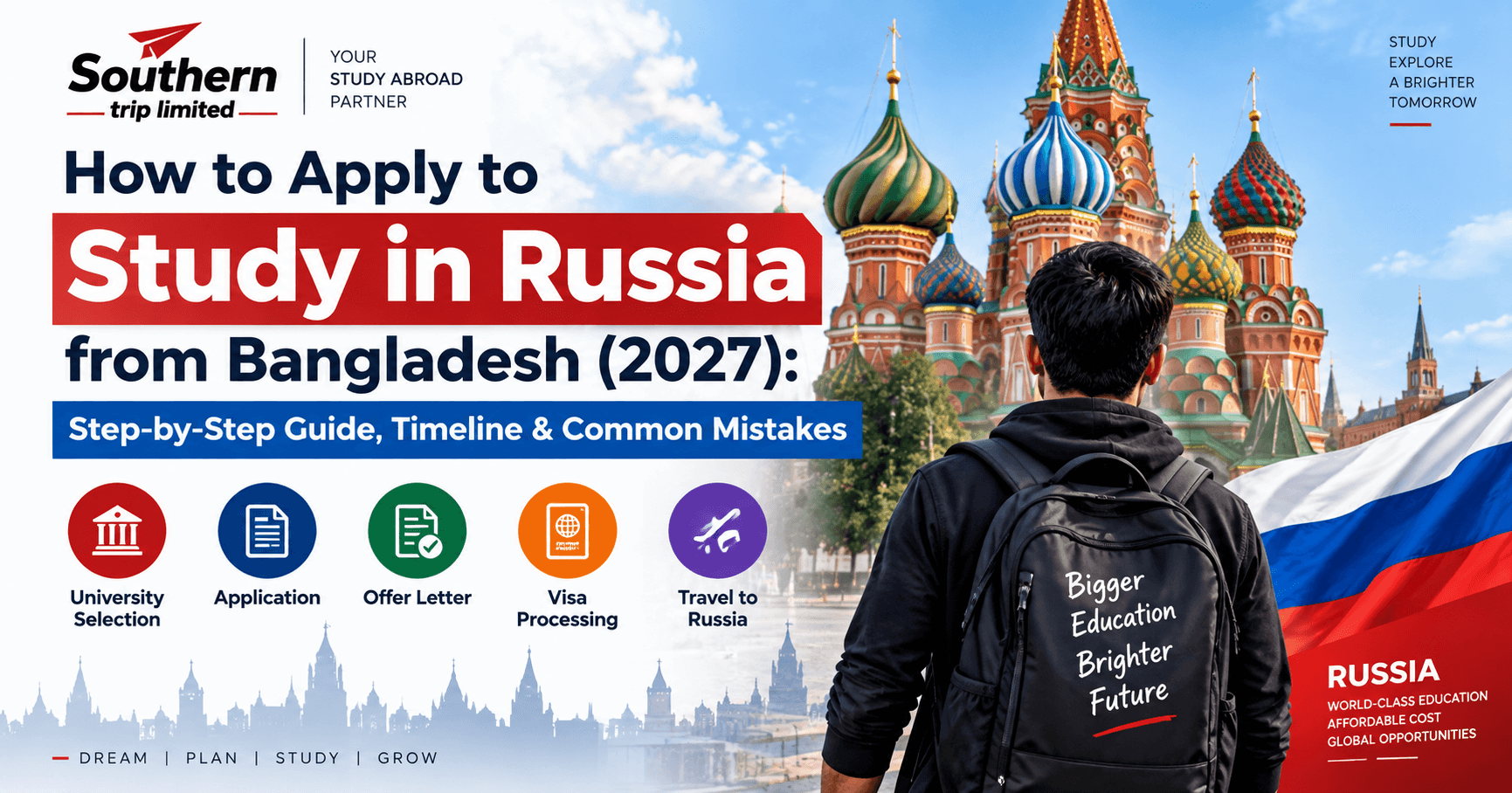
The real step-by-step application journey for studying in Russia from Bangladesh: timeline, documents, invitation letter, visa process, common mistakes and the decisions students actually face.
If you've already decided Russia is worth considering, the next question isn't "what programmes exist" — it's "what do I actually need to do, in what order, and when should I start?" This guide walks through the real application journey step by step, for the 2027 intake, including the decision points and mistakes that most often slow students down.
For the full reference details — university lists, programme options, tuition ranges and accommodation — see our Study in Russia destination page. This guide focuses on the process itself: the order things happen in, the decisions you'll actually face, and the mistakes that most commonly cost students time.
Every application is a little different, but the shape of the journey — shortlist, apply, get admitted, get invited, get your visa, travel — stays broadly the same. Understanding that shape in advance is what lets you plan around it instead of reacting to each stage as it arrives.
The Real Timeline: When to Start Preparing
Russian universities generally run their main intake around September, with university-specific deadlines and, at some institutions, an additional spring intake. Because admission, document preparation and the visa stage each take real time, most students benefit from starting several months ahead of their intended intake rather than a few weeks before.
A rough shape of the journey looks like this: shortlist and apply to universities first, wait for an admission decision, receive your invitation letter once accepted, then begin the visa stage — each step depends on the one before it, so delays early on push back everything that follows.
Step 1: Decide If Russia Is the Right Fit
Before shortlisting universities, it's worth confirming Russia genuinely matches your budget, subject interest and language comfort — our country comparison guide can help you check this against Malaysia, China and the UK before you commit time to a Russia-specific application.
If you're set on Russia, the next real decision is language track: an English-taught programme where available, or a Russian-taught programme that typically includes a preparatory year. This choice affects your timeline, so decide it early rather than partway through applications.
A preparatory year isn't a setback — for many students it's the difference between struggling through lectures in an unfamiliar language and starting the actual degree confidently. If your target programme is Russian-taught and you don't already speak Russian, budget the extra year into your plan from the start rather than treating it as a delay to avoid.
Step 2: Shortlist Universities and Programmes
Rather than applying broadly, most students do better shortlisting a realistic set of universities based on their subject, budget and academic profile. Our full Russia university directory lists the programmes we can accurately describe — use it to build a shortlist of 3–5 realistic options rather than a single university.
At this stage, confirm for each shortlisted programme: the language of instruction, whether a preparatory year applies to you, the tuition range, and the intake month — these details vary by university, not just by country.
It also helps to rank your shortlist realistically rather than treating every option as equally likely. Put 1–2 universities in a "strong fit" tier where your profile clearly matches their requirements, and 2–3 more in a "realistic backup" tier — this way, a single rejection or delayed decision doesn't derail your entire timeline.
Step 3: Prepare and Submit Your Application Documents
Most Russian university applications ask for a broadly similar core document set: passport copy, academic certificates and transcripts, passport-size photographs, and — depending on the programme — a statement of purpose or CV. Some universities also request specific application forms of their own.
The most common delay at this stage isn't missing documents — it's inconsistent documents: names, dates or spellings that don't match exactly across your passport, certificates and application form. Check this carefully before submitting anything.
A typical document set includes:
Valid passport with several months of remaining validity
Academic certificates and transcripts (SSC, HSC/Diploma, Bachelor's or Master's, as relevant)
Passport-size photographs meeting the university's specification
Statement of purpose or CV, where the programme requires one
Any university-specific application form or supplementary questionnaire
Exact requirements differ by university, so treat this as a starting checklist to confirm against — not a final list to submit blindly.
Step 4: Receive Your Invitation Letter and Apply for Your Visa
Once a university accepts you, it requests an official invitation letter on your behalf — this invitation is what allows you to begin the Russian student visa process at the embassy or visa centre in Dhaka, not the admission offer alone.
From there, the general visa stage involves completing the official Russian visa application form online, printing and signing it, then submitting it along with your passport, invitation, photo and any other requested documents at the embassy or visa application centre in Dhaka. Processing times and exact document requirements are set by the embassy, so always confirm the current checklist directly rather than relying on a previous year's list.
Once issued, a Russian student visa is typically granted for an initial period and can be extended for the duration of your study programme after arrival — the exact extension process is handled through your university and the local migration authority, not before you travel.
Visa decisions are made solely by the Russian embassy or immigration authority — no consultancy, including Southern Trip, can guarantee a visa outcome. What we can do is help you prepare a complete, accurate and well-organised application.
Step 5: Pre-Departure and Arrival
Once your visa is issued, the remaining steps are practical: booking travel, arranging initial accommodation (many universities offer dormitory housing), understanding your university's orientation process, and packing for the climate of your specific city. Russia's regions vary significantly in climate, so check what to expect for your specific destination city rather than assuming it's the same everywhere.
One step genuinely surprises many first-time students: Russian law requires foreign nationals to complete migration registration within a matter of days of arrival. If you live in a university dormitory, your university's international office typically handles this for you automatically as part of check-in; if you arrange private accommodation, you may need to register yourself at the local migration office. Confirm which applies to you with your university before you travel — missing this step is treated seriously by Russian authorities, so it isn't something to leave until you're settled in.
What the Application Process Itself Costs
Separate from tuition and living costs (covered on our Russia destination page), the application journey itself has its own smaller costs worth budgeting for upfront:
Application or processing fees charged by some universities when you submit your application
Document attestation and translation costs, if your certificates need to be translated or officially attested
Courier costs for sending physical documents where a university requires originals
Visa application fees charged by the embassy or visa application centre
None of these are large compared to overall tuition, but they add up and are easy to forget when budgeting only for tuition and living costs — plan for them as part of your application-stage budget, not an afterthought.
Common Mistakes That Delay a Russia Application
Applying to only one university. A single application leaves no backup if that university's timeline or requirements don't work out.
Assuming the invitation letter and the visa are the same step. They're sequential, not simultaneous — the invitation must exist before the visa stage can begin.
Leaving document attestation until the last minute. Attestation and translation can take longer than expected, especially close to an intake deadline.
Not confirming the language track before applying. Discovering after admission that a programme requires a preparatory year you didn't plan for can disrupt your whole timeline.
Booking flights before the visa is confirmed. Wait until your visa is actually issued before committing to non-refundable travel arrangements.
Underestimating how climate affects packing and settling in. Students who arrive unprepared for a Russian winter often spend their first weeks catching up rather than settling into classes.
Skipping a realistic budget check before committing. Confirm your full budget — tuition, hostel, visa costs and monthly living expenses together — before paying any non-refundable deposit.
Real Decision Points Students Face
A few genuine trade-offs come up repeatedly for Bangladeshi students applying to Russia, and it's worth thinking about them deliberately rather than deciding on the fly. None of these have a single right answer — they depend on how much time you have before your intended intake, how much budget flexibility you have, and how much risk you're comfortable taking on.
English-taught vs. Russian-taught with a prep year: English-taught programmes skip the language year but may offer a narrower subject choice at some universities; a prep year adds time but can open up Russian-taught programmes.
A major city vs. a smaller university city: Moscow and St. Petersburg offer more amenities and community size, while smaller cities are often more budget-friendly.
Applying early to more universities vs. waiting for a top-choice decision: Applying broadly and early protects your timeline; waiting on a single top choice risks losing the intake if it doesn't work out.
Self-funded vs. exploring scholarship options first: Applying for a scholarship can take longer and is never guaranteed, so weigh how much delay you can afford against the potential savings before deciding whether to wait on a scholarship decision or proceed self-funded.
There's no universally correct answer to any of these — the right choice depends on your own budget, academic goals and risk tolerance.
Keeping Your Application on Track
With several universities, documents and deadlines moving at once, it's easy for one detail to slip through unnoticed. A simple tracking approach helps:
List every shortlisted university with its own deadline, required documents and current status
Note which documents need attestation or translation, and start those early since they take the longest
Keep a single folder — physical or digital — with verified copies of every document you'll need more than once
Set your own internal deadlines a few weeks ahead of each real deadline, so a delay in one step doesn't put the whole timeline at risk
This kind of simple system is often the real difference between an application that goes smoothly and one that turns stressful in the final weeks before an intake.
How Southern Trip Supports Each Step
Southern Trip Ltd works with Bangladeshi students through every stage covered in this guide:
Helping you decide whether Russia is a realistic fit for your profile and budget
Guiding university and programme shortlisting based on your academic background
Reviewing your documents for consistency before submission
Explaining the invitation-letter and visa stages as they apply to your specific case
Preparing you for pre-departure requirements, including migration registration
See the full range of support on our services page. As with every stage of this guide, we help you prepare thoroughly — we do not guarantee admission or visa outcomes, since those decisions belong to universities and the Russian immigration authority.
When you're ready to start your Russia application, get your profile assessed or book a free counselling session with Southern Trip Ltd.
Frequently Asked Questions
It can be, particularly for students prioritising affordability alongside strong engineering, medicine or science programmes — though the right fit depends on your own profile and goals.
Not necessarily — some programmes are taught in English, while others are Russian-taught and may include a preparatory year. Always confirm the language requirement for your specific programme.
It varies by university and by the embassy's current processing times, which is exactly why starting several months ahead of your intended intake is safer than starting a few weeks before.
No — admission decisions are made by universities and visa decisions by the Russian embassy or immigration authority. We help you prepare a complete, accurate application, not guarantee its outcome.