
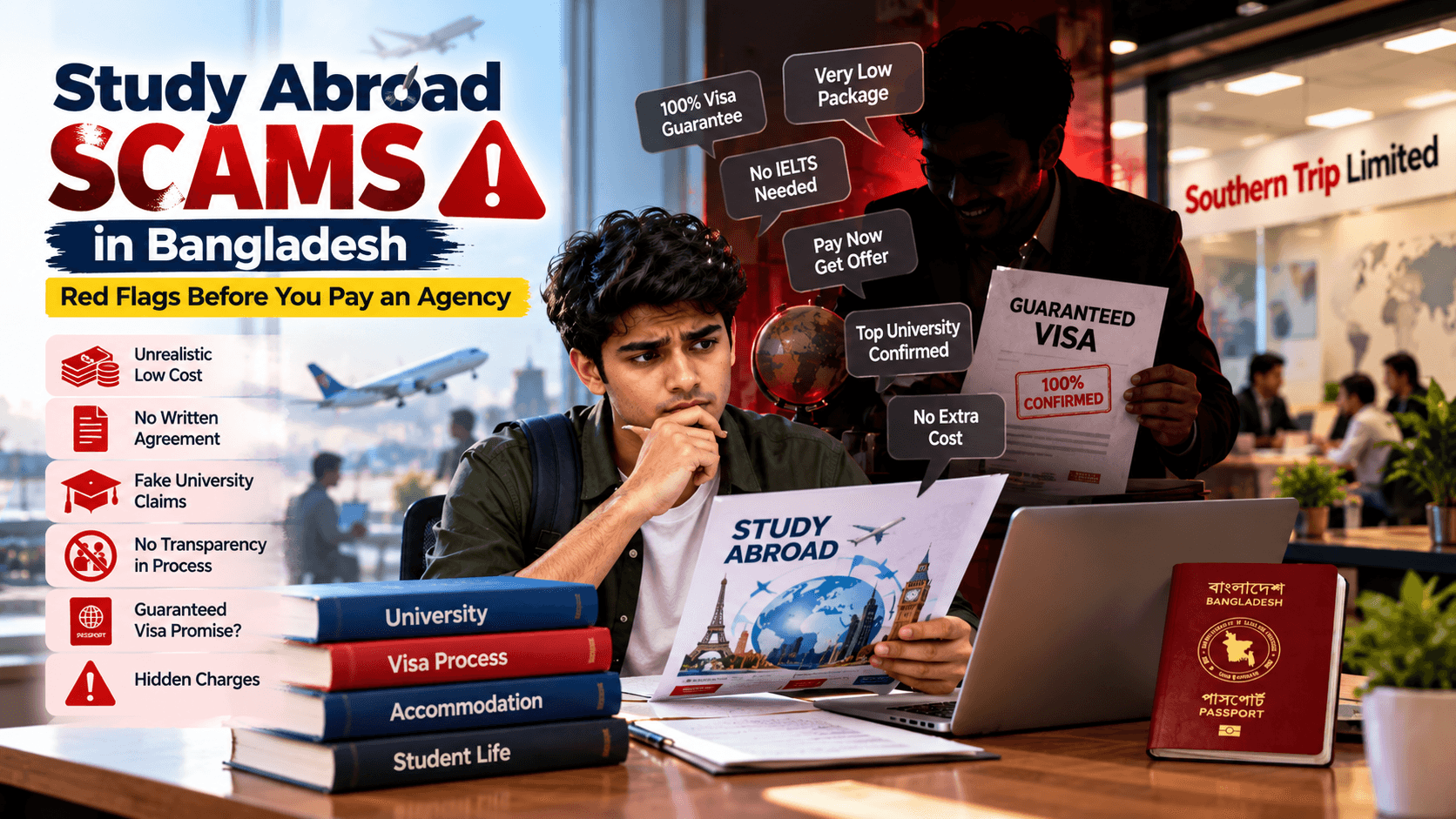
Spot study abroad scams before you pay: fake offers, visa guarantees, fake bank statements and payment traps, plus how to verify and what to do if scammed.
Study abroad scams in Bangladesh usually follow a familiar pattern. Someone promises a guaranteed visa, a "special" scholarship or an easy job abroad, then asks for money quickly, often in cash or to a personal account. Families can lose large sums, and students can lose a year or face visa refusals. The good news is that most scams share clear warning signs, and you can verify almost everything yourself through official university and government websites.
This guide explains the most common study abroad scams affecting Bangladeshi students, the red flags to look for before paying anyone, how to verify offers, visas and institutions, and what to do if you think you have been scammed.
Key Takeaways
No one can guarantee admission, scholarships or visas. A "100% visa guarantee" is a major red flag.
Never use fake documents or borrowed bank balances, even if an agent says it is "normal".
Pay universities and visa fees only through official channels, and always keep receipts.
Verify offers, institutions and visa steps directly on official websites.
If you suspect fraud, stop paying, keep all evidence and report it to the police and the relevant institution.
Why Study Abroad Scams Happen
Demand for studying abroad is high, and many families are unfamiliar with foreign admission and visa systems. Scammers exploit this gap with pressure, confusing promises and fake paperwork. According to a 2026 report in The Business Standard, Bangladesh has no dedicated regulator for education consultancies, so students must do their own checks before paying.
Common Study Abroad Scams Targeting Bangladeshi Students
1. Guaranteed Visa or Admission
Agents promise a guaranteed visa or admission in exchange for a large fee. In reality, universities decide admission, and immigration authorities decide visas. Study Australia states that no agent can guarantee the outcome of a Student visa application.
2. Fake Offer Letters and Admission Documents
Some students receive offer letters that the university never issued, or offers from institutions that do not exist. A genuine offer can normally be confirmed through the university's official applicant portal or its admissions office. Learn what a real offer contains in our guide to conditional and unconditional offer letters.
3. Fake or Unaccredited Institutions
Some agents push students towards institutions that are not properly recognised, or that offer little real teaching. Check the institution's status with official bodies. For example, the Malaysian Qualifications Agency's Malaysian Qualifications Register (MQR) lets anyone verify the status of accredited programmes in Malaysia. For the UK, the government publishes a register of licensed student sponsors.
4. Fake Bank Statements and "Show Money"
Agents may offer to "arrange" bank balances, solvency certificates or sponsor documents. Using false or borrowed financial evidence can lead to visa refusal and serious long-term consequences. Learn what genuine financial proof looks like in our student visa bank statement guide.
5. Study Visa as a Route to Full-Time Work
Some offers present a student visa as an easy way to work full time abroad and send money home. Student visas usually have strict work limits, and breaking them can lead to cancellation or removal. Always check work rights on the official immigration website of the country you are considering.
6. Fake Scholarships
Scammers advertise "fully funded" scholarships that require a processing or registration fee, or that promise selection without competition. Genuine scholarships are listed on the funder's or university's official website, with clear criteria and official application systems. See our scholarship guide for Bangladeshi students for legitimate options.
7. Visa Fee and Fake Website Scams
Fraudsters create websites or social media pages that look like official visa services and charge extra fees. For the UK, the University of Edinburgh reminds students that official UK government websites always end in ".gov.uk". Official fees are listed on the GOV.UK visa fees page.
8. Official Impersonation Calls and Emails
Scammers pretend to be immigration officials, embassy staff or university staff, claim there is a problem with your visa, and demand urgent payment. The University of Edinburgh warns that UK Home Office officials will never ask you to send money by bank transfer. UKCISA gives similar warnings about fake "fines" and threats of deportation.
9. Tuition Payment and "Discount" Scams
Someone offers to pay your tuition deposit at a "discount", or asks you to send tuition money to a personal or third-party account. Pay universities only through their official payment methods, and confirm the payment details with the university directly.
10. Passport and Document Withholding
Some agents keep students' passports or original certificates to pressure them into paying more. Do not hand over original documents without a clear reason and a written receipt, and ask for them back as soon as they are no longer needed.
Red Flags Before You Pay an Agency
Guarantees of admission, scholarships or visas
Offers to arrange fake documents, bank balances or work experience
Pressure to pay today because "seats are limited"
Payment requested in cash or to a personal account, with no official receipt
No written agreement, fee list or refund policy
Refusal to share university emails, portal logins or offer letters with you
Claims that students can work full time abroad without restriction
No verifiable office, trade licence or company registration
Unrealistic "low cost" packages with no clear breakdown
For a full checklist to compare agencies, read our guide on how to choose a study abroad consultancy in Bangladesh.
Warning Signs at Each Stage
First contact: Unsolicited messages on social media, "limited seats" pressure, or promises that sound too easy.
Counselling: Only one country or institution is suggested, with no explanation, or your results and budget are ignored.
Application: You are not allowed to see your application, or the agent uses only their own email address.
Offer stage: An offer arrives unusually fast, cannot be found in the university portal, or asks you to pay a personal account.
Visa stage: You are offered "arranged" bank balances, pre-written interview answers or unofficial visa payment links.
Pre-departure: New, unexplained fees appear, or your original documents or passport are not returned.
How to Verify Before You Pay
Check the institution on official registers or accreditation bodies, such as the UK register of licensed student sponsors or Malaysia's MQR.
Confirm your offer through the university's official portal or by emailing its admissions office from the address on its website.
Check the agent with the university. Ask whether the agency is an approved partner, and search the British Council's database of certified counsellors for UK counsellors.
Check visa rules and fees on the official immigration website of your destination country.
Check scholarships on the funder's or university's official website.
Check payment details directly with the university before transferring any money.
Get everything in writing, including fees, services and refund terms.
Safe Payment Habits
Pay universities through their official payment channels, in the name of the student.
Pay agency service fees only to the company's official bank account, and get an official receipt.
Pay visa fees only through the official visa application system.
Avoid paying large amounts in cash.
Keep copies of every agreement, receipt, email and message.
What to Do If You Have Been Scammed
Stop paying. Do not send more money, even if you are promised a refund after "one more payment".
Collect evidence: receipts, bank transfer records, agreements, messages, emails, phone numbers and names.
Contact your bank or mobile financial service provider immediately to report the transaction.
Report to the police. In Bangladesh, you can file a General Diary (GD) or a case at your local police station.
Inform the university or scholarship body whose name was used, so it can warn other students.
Seek legal advice if large sums are involved.
Warn others by sharing factual information without making claims you cannot prove.
Common Mistakes That Make Families Vulnerable
Trusting a relative's or neighbour's recommendation without checking the agency yourself.
Believing that a higher fee means a higher chance of a visa.
Signing documents you have not read, or that are not in a language you understand.
Letting the agent control all communication with the university.
Making decisions under time pressure.
Understand the real process in our step-by-step university application guide, so it is easier to spot anything that does not make sense.
Frequently Asked Questions
How can I tell if a study abroad agency is a scam?
Warning signs include guaranteed visas, offers of fake documents, pressure to pay quickly, payments to personal accounts, and no written agreement or receipts. Verify the agency's registration and its university partnerships directly.
Can an agency guarantee my student visa?
No. Visa decisions are made by immigration authorities. Anyone guaranteeing a visa is misleading you.
How do I check if my offer letter is real?
Log in to the university's official applicant portal, or contact its admissions office using details from the university's official website.
Is it safe to use a "bank solvency" service offered by an agent?
No, if it involves borrowed or fake funds. Your financial evidence must be genuine and show money that is actually available for your studies.
Do genuine scholarships charge an application fee?
Many genuine scholarships do not charge an application fee. Be very careful with any "scholarship" that asks for payment to secure selection, and verify it on the funder's official website.
What should I do if I paid a fake agent?
Stop paying, gather all evidence, contact your bank or mobile financial service, and report the matter to your local police station. Also inform the university whose name was used.
Can I apply to universities without an agent to avoid scams?
Yes. Most universities accept direct applications. If you use an agent, choose one carefully and stay involved in every step.
Get Honest Guidance from Southern Trip Limited
Southern Trip Limited believes students and families should understand every step and every payment. We provide profile-based counselling and guidance on verifying offers and visa steps for Russia, Malaysia, China, South Korea and the UK. Ask us anything on the red-flag list above before you decide.
Admission, scholarship and visa decisions are made by universities, scholarship bodies and immigration authorities, so no consultancy can guarantee them. Get your profile assessed or book a free counselling session to check your plan safely.
Information in this article was checked against official and published sources in September 2026 and may change. Always verify details directly with universities and official authorities.
Planning to Study Abroad?
Speak with our team to compare your options and choose the right next step.