
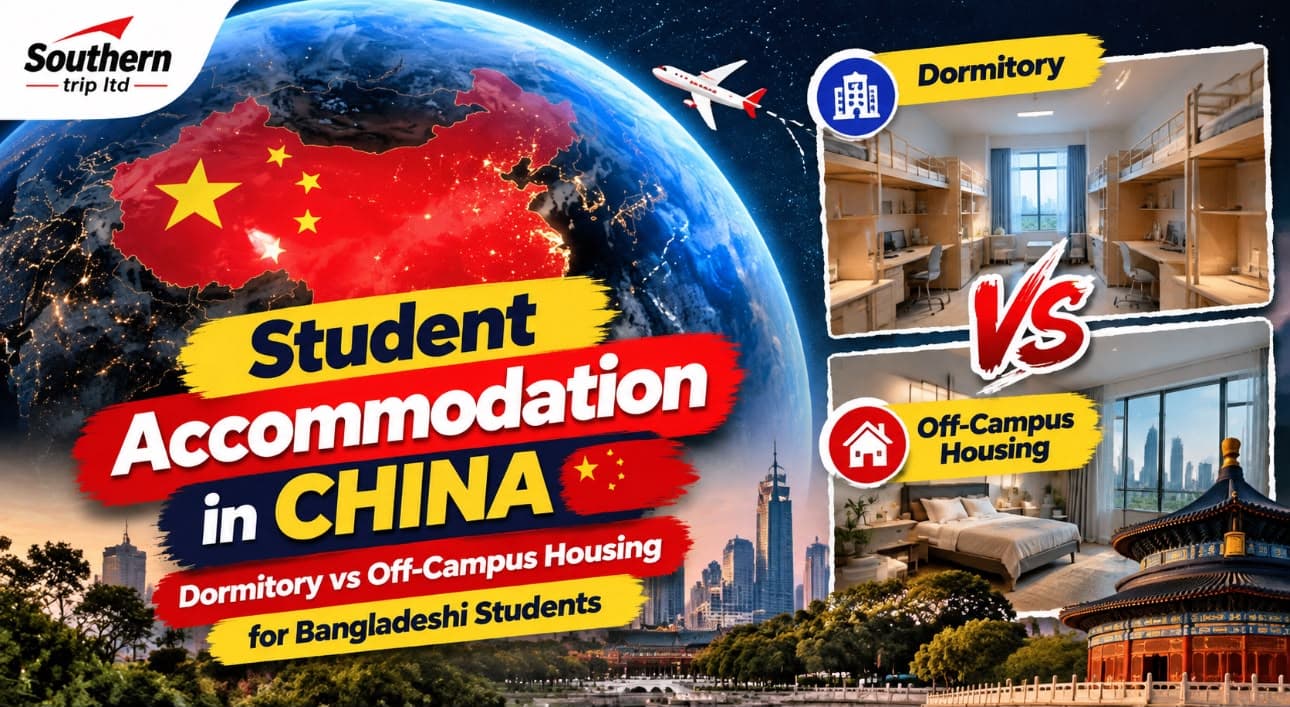
Dormitory or off-campus flat? Compare student accommodation in China for Bangladeshi students: official dorm fees, rental costs, CSC housing benefits and the 24-hour police registration rule.
For most Bangladeshi students, the best student accommodation in China for the first year is the university's international student dormitory. It is usually the simplest to arrange from Dhaka, is located on or near campus, and automatically sorts out your residence registration with the police. Off-campus housing can give you more space and privacy, but it brings extra costs, a rental contract in Chinese, and a legal duty to register your address with the local police within 24 hours.
This guide compares both options using official university and government information, explains what dormitories really cost, and shows Bangladeshi students and guardians how to book housing, avoid rental mistakes and stay on the right side of China's residence rules.
Key Takeaways
Most international students in China live in on-campus international student dormitories, especially in their first year.
Dorm fees vary widely by university, city and room type. Published examples range from about RMB 450 per person per month for a shared quad room to RMB 24,000 or more per room per academic year at top universities.
On-campus rooms are often limited and must be reserved online after you receive your admission notice. If you miss the booking window, you may have to find housing off campus.
If you live off campus, Chinese law requires your address to be registered with the local police within 24 hours of arrival. You need this registration for your residence permit.
Full Chinese Government Scholarship (CSC) students normally receive a free university dormitory or an accommodation subsidy, but the exact arrangement depends on the host university.
Always confirm room type, payment period, deposit, utilities and move-in date in writing before you fly.
Dormitory vs Off-Campus Housing: Quick Comparison
Here is how the two main choices compare for a typical Bangladeshi student:
Booking: Dormitories are booked through the university's online system after admission. Off-campus flats are usually found through agents or rental platforms after you arrive.
Cost: Dormitories are usually the cheaper option in the same city. Off-campus rent is often higher and usually comes with a deposit, advance rent and possibly an agent fee.
Police registration: On-campus residents register through the dorm reception. Off-campus tenants must register themselves at the local police station within 24 hours.
Contract: Dorms use a standard university accommodation agreement. Private rentals need a lease that you must read carefully, usually written in Chinese.
Privacy and space: Dorms are often shared rooms with dorm rules. Off-campus flats give more independence and usually a private kitchen.
Best for: Dorms suit first-year, bachelor's and most scholarship students. Off-campus housing suits experienced students, couples and some postgraduate researchers.
Option 1: University Dormitories for International Students
Most Chinese universities have dedicated international student dormitories, sometimes called international student apartments or halls. They are usually separate from Chinese students' dormitories and are managed by the university's international student office or a housing service centre.
Room types you will usually see
Single rooms: One student per room, more privacy and a higher price. Often preferred by master's and PhD students.
Double or twin rooms: Two students share a room. This is the most common choice for international students.
Triple and quad rooms: Three or four students share a room. These are the cheapest options where available.
En-suite or suite rooms: Some newer buildings offer rooms with a private bathroom, or suites where several bedrooms share one bathroom and a common area.
A typical room includes a bed, desk, chair, wardrobe or locker, air conditioning and campus internet. Shared facilities may include bathrooms, laundry, common kitchens and study rooms. For example, Zhejiang University's on-campus accommodation page lists a bed, mattress, desk, chair, locker, air conditioning, hot water, bathroom and campus network in its rooms, with kitchens and self-service laundry in some buildings.
Advantages of living in a dormitory
Easy to arrange from Bangladesh: You can reserve a room online before you travel and move in on arrival.
Police registration handled locally: On-campus residents normally complete their residence registration through the dormitory front desk.
Location: You live a short walk from classes, libraries, canteens and the international office.
Community: You meet other international students quickly, which helps a lot in the first few months.
Safety and support: Buildings usually have reception staff, controlled entry and maintenance support.
Disadvantages to know before you book
Limited places: Rooms can fill up fast. Tsinghua University advises students to reserve in advance because on-campus space is limited.
Dorm rules: Universities may have rules on visitors, cooking appliances, electricity use, quiet hours and building access times.
Shared space: You may share a room and bathroom with students from different countries and cultures.
Payment in advance: Many universities collect fees per semester or per academic year, not month by month.
How Much Does a University Dormitory Cost in China?
There is no single national dormitory fee. Prices depend on the university, city, building and room type, and universities update their fees from time to time. The examples below come from official university pages and are meant to show the range, not to replace your own university's current fee list.
Central China Normal University (Wuhan): its international student dormitory page lists RMB 450 per person per month for a quad room, RMB 600 for a triple, RMB 750 for a double with bunk beds, RMB 900 for a double room and RMB 1,200 for a single room.
Tsinghua University (Beijing): its accommodation page lists RMB 40 per day for a double room and RMB 80 per day for a single room. The page dates from 2021, so check the current rate in your admission package.
East China University of Science and Technology (Shanghai): its accommodation page lists single rooms at RMB 80 to 110 per day, payable for the full semester including winter and summer vacations.
Zhejiang University (Hangzhou): under the fee standard effective from 1 January 2023, its long-term rates start at RMB 24,000 per room per academic year for a single room and RMB 36,000 per room per academic year for a twin room. Long-term fees exclude utilities and bedding.
To get a rough idea in taka: at about BDT 18.3 per Chinese yuan (the exchange rate on 2 October 2026), RMB 450 per month is roughly BDT 8,200, RMB 900 is roughly BDT 16,500, and RMB 24,000 per year is roughly BDT 4.4 lakh. Exchange rates change, so recalculate before you pay.
Extra costs that are often not included
Electricity, water and sometimes air-conditioning use
Bedding, pillows and blankets, if the university does not supply them
A room or key deposit
Charges for staying during winter or summer vacation, if not already included
Mobile data, unless the dorm provides it, plus laundry costs
For a full first-year budget, including tuition, food, insurance and visa costs, read our guide to the cost of studying in China from Bangladesh.
Option 2: Off-Campus Housing in China
Off-campus housing usually means renting a private apartment or a room in a shared flat near the university. Some students choose it after their first year, once they understand the city and have Chinese-speaking friends who can help.
When off-campus housing makes sense
You could not get a dormitory place, or the university has no dorm space left for your programme.
You are a postgraduate or PhD student who wants a quiet place to study and cook.
You are coming with a spouse or family. Many universities do not provide family accommodation; Zhejiang University, for example, states that it does not.
You have already lived in China for a year and understand rental practices in your city.
Costs to expect off campus
Rent varies far more than dormitory fees. A flat in central Beijing, Shanghai or Shenzhen can cost several times more than a similar flat in a smaller city. On top of monthly rent, budget for:
A security deposit, often equal to one or more months' rent
Rent paid in advance, sometimes for several months at a time
An agent fee if you use a property agency
Electricity, water, gas, internet and property management charges
Basic furniture and kitchen items if the flat is not fully furnished
Because payment terms differ between landlords and cities, ask for the full move-in cost in writing before you agree.
Safety checklist before renting privately
Tsinghua University's advice for off-campus students is a useful checklist for anyone renting in China:
Use a legal, reputable housing agency and inspect the flat and surrounding area in person.
Check that the landlord owns the property or has the right to rent it out.
Confirm before moving in that the landlord can provide the documents needed for your police residence registration.
Make sure every promise is written into the contract. Verbal promises do not count.
Get receipts for all deposits and rent. If a payment is described as 定金 or 订金, ask exactly what the refund terms are: these two similar-sounding Chinese words carry different refund rules.
Do not pay any deposit until a full agreement has been formally reached.
Never send money to a "landlord" you have only met online, and be careful of anyone who asks for payment before you have seen the property. Our guide to study abroad scams and red flags explains similar warning signs.
The 24-Hour Police Registration Rule
This is the most important legal point for students who live off campus. Under Article 39 of the Exit and Entry Administration Law of the People's Republic of China, foreigners who stay somewhere other than a hotel, or the people who host them, must register with the local public security office within 24 hours of arrival.
In practice, university procedures look like this. Shanghai University of Finance and Economics, for example, asks off-campus students to:
Sign a tenancy contract with the landlord.
Collect and complete the university's off-campus registration form.
Take the passport, the form, the tenancy contract and the landlord's documents to the local police station within 24 hours of moving in.
Receive the Registration Form of Temporary Residence and keep it safely.
You will normally need this registration form when you apply for or renew your residence permit. Universities also ask students to register again when they change address or passport, and after re-entering China on an X1 or X2 visa. For on-campus students, the dormitory front desk usually handles registration; Zhejiang University and ECUST, for example, ask new residents to check in with their documents within 24 hours of arrival.
For more on X1 and X2 visas and the residence permit, see our China student visa guide for Bangladeshi students.
Accommodation for CSC and Other Scholarship Students
The Chinese Government Scholarship generally covers accommodation. The 2026 CSC application guide published by Beijing Language and Culture University lists a "free university dormitory or accommodation subsidy" alongside monthly stipends of CNY 2,500 for undergraduates, CNY 3,000 for master's students and CNY 3,500 for doctoral students.
Points to remember:
Full scholarship students are often assigned a room automatically. Tsinghua, for example, says full CSC students do not need to book.
A free room usually means a standard room type chosen by the university, often a shared room. Upgrading may cost extra.
Some universities pay an accommodation subsidy only if you have prior approval to live off campus. Check this before signing any lease.
Even if the room fee is covered, you may still need to sign an accommodation contract and pay utilities. ECUST, for example, states that full-scholarship students must still sign the accommodation contract.
Partial scholarships and university scholarships may not include accommodation at all.
Explore funding options in our guide to China scholarships for Bangladeshi students. Scholarship benefits are set by the scholarship provider and university each year, so always check the official notice for your intake.
How to Book University Accommodation in China
Receive your admission notice. Booking details are usually sent with your admission package or published on the international student office website.
Watch the booking window. Many universities open online dorm reservations at a fixed time. Zhejiang University states that students without a successful reservation will not be assigned on-campus housing.
Choose your room type. Compare price, number of roommates, bathroom arrangement and building location.
Check the payment terms. Confirm whether you pay per day, month, semester or academic year, whether vacations are included, and whether a deposit is required.
Plan your arrival date. Check the earliest move-in date. Arriving too early may mean paying for a hotel first.
Check in within 24 hours. Bring your passport, visa, admission notice and any booking confirmation to the dorm reception.
Practical Tips for Bangladeshi Students
Food and cooking: Many universities have a halal or Muslim canteen, but this varies by campus. If you plan to cook Bangladeshi food, ask whether your building has a shared kitchen and which appliances are allowed in rooms.
Weather: Northern Chinese cities can be very cold in winter, while southern cities can be hot and humid. Pack for your city's climate and ask how heating works in your building.
What to bring: Bring a plug adapter, some warm clothing, important medicines with prescriptions, passport photos and copies of your documents. Check whether bedding is included before packing it.
Roommates: Sharing with students from other countries is a good way to improve your English and Chinese, but agree early on cleaning, guests and quiet hours.
Payments: Find out whether dorm fees can be paid by bank transfer, card or Chinese mobile payment, and keep every receipt.
Location choice: If you move off campus, live close to your campus gate or a metro line. Cheaper rent far away can cost you time and transport money every day.
Comparing destinations? Our guides to student accommodation in Malaysia and student accommodation in Russia explain how housing works in our other main study destinations.
Common Mistakes to Avoid
Missing the online dorm booking window and arriving with nowhere to stay
Assuming a scholarship covers every housing cost, including utilities and upgrades
Signing a Chinese-language lease without understanding the deposit and exit terms
Forgetting to register an off-campus address with the police within 24 hours
Not updating registration after moving, changing passport or returning from a trip abroad
Paying deposits to unverified agents or online contacts
Budgeting with old fee figures instead of the university's current notice
Frequently Asked Questions
Is accommodation free for international students in China?
Not usually. Self-funded students pay dormitory or rent fees. Full Chinese Government Scholarship holders normally receive a free university dormitory or an accommodation subsidy, and some university scholarships also cover housing. Check your scholarship letter for the exact benefit.
How much is a university dormitory in China per month?
It depends on the university and room type. Official examples include about RMB 450 per person per month for a quad room at Central China Normal University and RMB 1,200 for a single room there, while top universities in big cities can charge much more. Always use your own university's current fee list.
Can international students live off campus in China?
Yes, in most cases, but you must follow your university's rules and register your address with the local police within 24 hours of moving in. Some universities also require you to inform or get approval from the international student office first.
Do international students live with Chinese students in China?
Usually not. Most universities place international students in separate international dormitories, often shared with students from other countries. Arrangements vary, so check your university's accommodation information.
What happens if I do not register my address with the police?
Registration is a legal requirement under China's Exit and Entry Administration Law, and you will normally need the registration form for your residence permit. Failing to register can create problems with your residence permit and may lead to penalties, so complete it on time.
Should a first-year Bangladeshi student choose a dormitory or a flat?
For most first-year students, a university dormitory is the safer and simpler choice. You avoid lease risks, live close to classes and get help with registration. You can consider moving off campus later once you know the city.
When should I book my dormitory in China?
Book as soon as your university opens reservations, which is usually after you receive your admission notice and before the semester starts. Places can be limited, so watch the international office website and your email closely.
Get Help Planning Your Accommodation in China
Choosing the right university also decides where and how you will live. If you are still shortlisting, start with our guide to the best universities in China for Bangladeshi students, or visit our Study in China page.
Southern Trip Limited helps Bangladeshi students compare universities, understand dormitory options and fees, prepare admission and visa documents, and plan arrival in China. We share up-to-date information from universities, but we cannot guarantee admission, scholarships, visas or room allocation, as these decisions are made by universities and authorities. Contact Southern Trip Limited to book a counselling session and plan your study in China with confidence.
Information in this article was checked against official university and government sources in October 2026. Fees, scholarship benefits and rules can change, so please confirm the latest details with your university before making payments.