
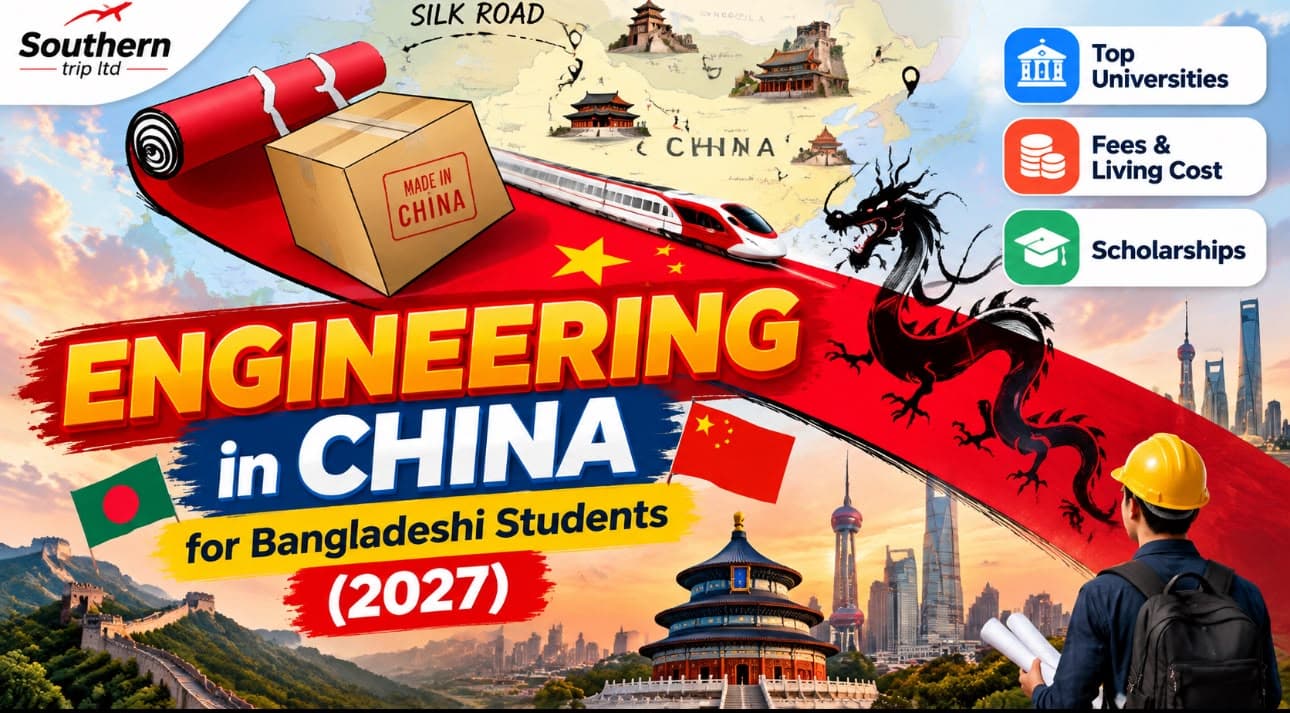
Planning to study engineering in China? Compare top engineering universities, official 2026 tuition, CSCA subjects, scholarships, Washington Accord recognition and the 2027 application timeline for Bangladeshi students.
Engineering in China for Bangladeshi students is one of the strongest study-abroad options for science graduates. China has large public engineering universities, many programmes accredited under a system recognised by the Washington Accord, and scholarships at every level. Bangladeshi students can start a four-year bachelor's after HSC, or a master's or PhD after graduation. Official 2026 tuition for English-taught engineering bachelor's degrees ranged from about CNY 25,500 to CNY 80,000 a year, depending on the university and programme. Chinese-taught options are often cheaper. Most undergraduate applicants now also need the CSCA test, usually in Mathematics and Physics.
This guide helps Bangladeshi students and guardians compare engineering subjects, universities, fees, scholarships, accreditation, entry requirements and the 2027 application timeline. Figures come from official 2026 university guides and may change for 2027.
Key Takeaways
China and Bangladesh are both full signatories of the Washington Accord, the international agreement on accredited engineering degrees. China joined in 2016 and Bangladesh in 2023. Recognition applies to accredited programmes, so check your programme's accreditation status.
Official 2026 English-taught bachelor's examples: Dalian University of Technology (DUT) CNY 25,500, Harbin Institute of Technology (HIT) CNY 26,000 and Zhejiang University (ZJU) engineering programmes CNY 80,000 a year.
For 2026 entry, the CSCA test was required at universities such as HIT, ZJU and Xi'an Jiaotong. ZJU's English-taught engineering programmes required Mathematics and Physics.
English-taught engineering usually asks for IELTS 5.5–6.0, TOEFL around 80 or Duolingo 100–110. Chinese-taught engineering usually asks for HSK 4 or higher.
Full scholarships, such as the CSC and some university awards, are competitive. Many engineering students are self-funded or partly funded.
Why Study Engineering in China?
Engineering-focused universities: Institutions such as Harbin Institute of Technology, Beihang University, Dalian University of Technology, Xi'an Jiaotong University and Huazhong University of Science and Technology are known for engineering and technology.
Accreditation: According to the China Association for Science and Technology (CAST), China's engineering accreditation body had accredited 2,441 programmes at 322 universities as of December 2025.
Lab and industry exposure: Many programmes offer this in manufacturing, electronics, energy, materials and infrastructure.
Funding at every level: Scholarships are available for bachelor's, master's and PhD study.
Relevance to Bangladesh: Bangladesh–China cooperation in power, infrastructure, telecoms and manufacturing makes the experience relevant at home.
The main trade-off is language. Most engineering programmes are Chinese-taught, and English-taught options are fewer and often more expensive. For a wider overview, see our guide to English-taught programmes in China.
Washington Accord and Recognition in Bangladesh
The International Engineering Alliance lists China, represented by CAST, as a full Washington Accord signatory since 2016. It lists Bangladesh as a full signatory with recognition from 2023, after provisional status in 2016. In practice, signatories recognise engineering degrees that their accreditation bodies have accredited as substantially equivalent.
What this means for you:
Ask the university whether your specific programme is accredited by China's engineering accreditation body (CEEAA), and since when.
Recognition depends on the programme and its accreditation dates, not just the university's name or ranking.
If you plan to work as an engineer in Bangladesh or join a professional body, check the current requirements of the relevant Bangladeshi bodies, such as the Institution of Engineers, Bangladesh (IEB).
Popular Engineering Subjects for Bangladeshi Students
Electrical and electronic engineering: ZJU offered English-taught Electrical Engineering and Automation, Information Engineering and Electronic Science and Technology for 2026.
Computer science and software engineering: These are widely offered, including English-taught Computing Science in the CSU–University of Dundee joint programme.
Mechanical and intelligent manufacturing: XJTU offered English-taught Intelligent Manufacturing Engineering, and CSU offered Mechanical Engineering.
Civil engineering: English-taught at CSU through its joint programme with Dundee.
Energy, power and materials engineering: XJTU offered Energy and Power Engineering and Materials Science and Engineering in English.
Automation, optics and aerospace-related fields: Offered at universities such as ZJU and Beihang.
Programme lists change every year, so check each university's current catalogue. For a shortlist by reputation, see the best universities in China for Bangladeshi students.
Engineering Tuition Fees in China: 2026 Official Examples
Bachelor's (4 years)
Dalian University of Technology (English-taught): CNY 25,500 a year, plus an application fee of CNY 800.
Harbin Institute of Technology: CNY 26,000 a year for English-taught and CNY 20,000 for Chinese-taught programmes, with an application fee of CNY 400 (self-funded).
Central South University–University of Dundee joint programmes (English-taught): CNY 69,000 a year for Civil Engineering, Mechanical Engineering and Computing Science.
Zhejiang University (English-taught): CNY 80,000 a year for Electrical Engineering and Automation, Information Engineering, Electronic Science and Technology, Automation, and Optical Information Science and Engineering.
Master's and PhD
DUT English-taught master's (3 years): CNY 29,500 a year for science, technology, economics and management.
Central South University, sciences and engineering: Master's tuition was CNY 29,000 (Chinese-taught) or CNY 35,000 (English-taught) a year. PhD tuition was CNY 38,000 or CNY 44,000 a year.
Add accommodation, food, insurance, the visa and flights to your budget. Our cost of studying in China from Bangladesh guide breaks this down in BDT.
Entry Requirements
Bachelor's in engineering
Education: HSC (Science) or equivalent, with strong Mathematics and Physics. Chemistry also matters for some majors.
Age: This varies by university. XJTU set under 25, DUT 18–25, and HIT under 30 (under 25 for HIT scholarship applicants).
English: DUT asked for IELTS 5.5, TOEFL 80 or Duolingo 100. HIT asked for IELTS above 6.0 (no band below 5.5) or TOEFL above 80. XJTU asked for IELTS 6.0, TOEFL 80 or Duolingo 110.
Chinese-taught: HIT asked for HSK 4 with a score of 210 or higher.
CSCA: ZJU's English-taught engineering programmes required Mathematics and Physics. Check each university's 2027 subject list.
For the full after-HSC route, read our guide to studying abroad after HSC. If you lack IELTS, see studying in China without IELTS.
Master's and PhD in engineering
Degree: A relevant bachelor's degree for a master's, or a master's degree for a PhD.
Age: Usually under 35 for a master's and under 40 for a PhD, the same limits the CSC uses.
Documents: Two recommendation letters from professors or associate professors, a study plan or research proposal, and ideally a supervisor's acceptance letter.
Engineering Scholarships in China
Chinese Government Scholarship (CSC): Type A applications go through the Chinese Embassy in Bangladesh, whose last deadline was 10 January 2026. Type B goes through universities. The embassy listed tuition, accommodation, insurance, a monthly allowance of roughly CNY 2,500–3,500 depending on level, and round-trip airfare.
University scholarships: HIT, for example, ran an International Students Scholarship from 1 October 2025 to 15 July 2026 for applicants under 25.
Provincial and city scholarships, plus Silk Road and MOFCOM programmes: These are offered through selected universities, mainly for postgraduate study.
Engineering is a popular field for scholarships, so competition is strong. Good grades, a strong CSCA score and, for postgraduates, research fit with a supervisor make a real difference. See our China scholarship guide for Type A versus Type B strategy.
How to Choose the Right Engineering Programme
Check accreditation: Ask whether the programme is CEEAA-accredited.
Confirm the teaching language for all four years, including labs and final projects.
Compare the four-year total cost, not only the first year's tuition.
Look at labs, internships and industry links in your field.
Match the CSCA subjects to your strengths. Mathematics and Physics are common for engineering.
Think about the city: it affects living costs, climate and industry exposure.
2027 Application Timeline
October–December 2026: Shortlist programmes, take an English test, register for the CSCA, and for postgraduate study, contact supervisors.
November 2026–February 2027: Early application phases open. XJTU's first 2026 phase ran from 1 November to 31 December 2025. CSC deadlines also fall in this window.
March–July 2027: Later phases and self-funded deadlines. In 2026, XJTU ran until 30 June, DUT accepted applications until June, and HIT until 15 July.
July–August 2027: Admission notice, JW201/JW202 and the X1 visa.
September 2027: Arrival and registration.
Student Visa (X1) from Bangladesh
Engineering students apply for an X1 visa. According to the Chinese Embassy in Bangladesh, you apply online through the Chinese Visa Application Service Center and submit your passport in Dhaka. You need the JW201 or JW202 form, the original admission letter, and either scholarship proof or a bank statement showing at least USD 2,500 a year. See our China student visa guide for details.
Common Mistakes to Avoid
Assuming every engineering degree in China is automatically recognised, without checking programme accreditation.
Choosing an English-taught programme without checking whether all courses are actually in English.
Ignoring CSCA subject requirements until the deadline is close.
Comparing a CNY 25,500 programme and a CNY 80,000 programme on ranking alone, without weighing value.
Relying on part-time work. It needs university and immigration approval.
Trusting anyone who promises guaranteed admission, scholarships, jobs or visas.
Frequently Asked Questions
Is an engineering degree from China valid in Bangladesh?
China and Bangladesh are both full Washington Accord signatories, which supports recognition of accredited engineering programmes. Check that your programme is accredited and confirm current requirements with the relevant Bangladeshi professional bodies.
How much does engineering in China cost?
Official 2026 English-taught bachelor's tuition ranged from CNY 25,500 (DUT) to CNY 80,000 (ZJU) a year. HIT's Chinese-taught tuition was CNY 20,000. Living costs are extra.
Can I study engineering in China in English?
Yes, at a number of universities, but the choice is narrower than for Chinese-taught programmes. Check the teaching language for the whole programme.
Which CSCA subjects are needed for engineering?
Usually Mathematics and Physics. ZJU's English-taught engineering programmes required both in 2026. Each university sets its own subjects.
Can I get a scholarship for engineering in China?
Yes. Options include the CSC and university and provincial scholarships. Competition is strong, and requirements differ by level and university.
Which universities in China are best for engineering?
Well-known engineering-focused universities include HIT, Beihang, DUT, XJTU, HUST and ZJU. The best choice depends on your subject, budget, language and scholarship route.
Plan Your Engineering Degree in China with Southern Trip Limited
Southern Trip Limited helps Bangladeshi students compare engineering programmes and accreditation, choose universities that fit their budget, prepare for the CSCA and application documents, apply for suitable scholarships, and complete the X1 visa file. Admission and scholarship decisions rest with the universities and the scholarship authorities. We help you apply with a clear plan.
Book a free counselling session or get your profile assessed to plan your engineering degree in China for 2027. You can also explore our Study in China services and the full study in China from Bangladesh guide.
Information checked in October 2026 using official university guides, CAST, the International Engineering Alliance and Chinese embassy sources. Fees, programmes, CSCA subjects and deadlines can change each year, so always confirm before applying.