
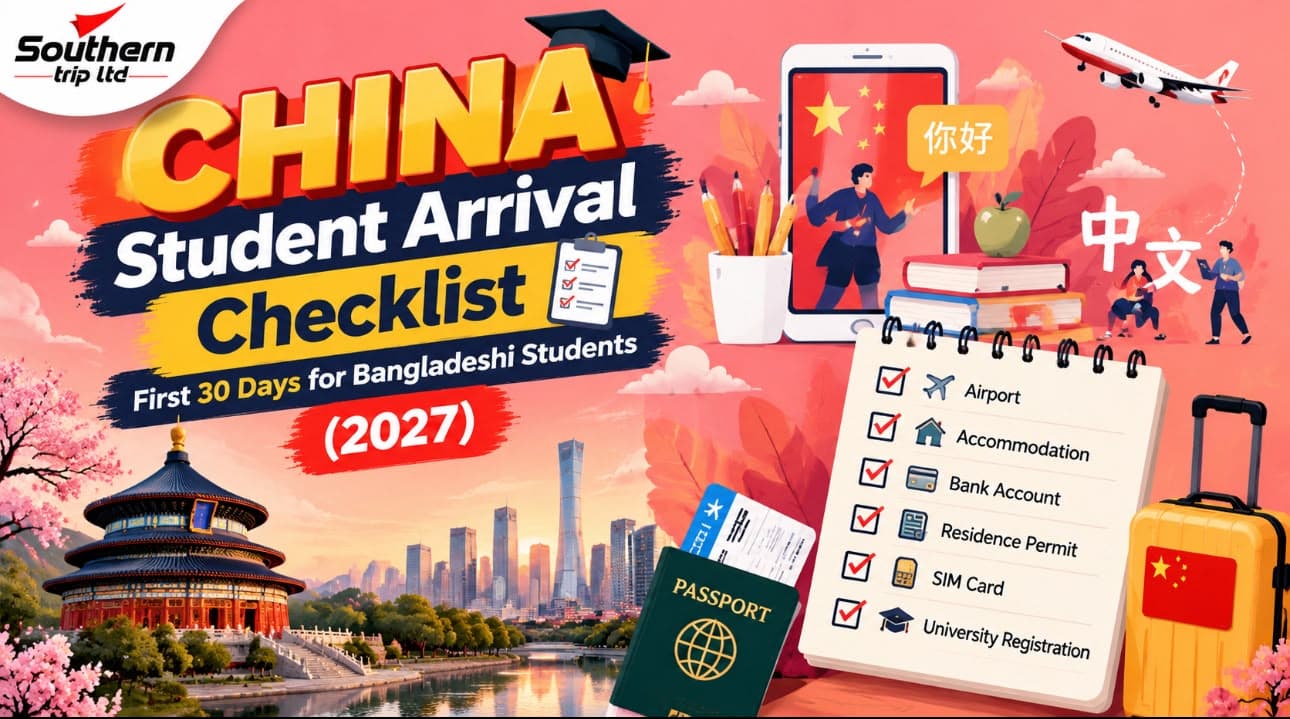
Just landed in China? Follow this step-by-step first-30-days checklist: 24-hour registration, university enrolment, insurance, health check, residence permit, SIM, bank and payments.
Your first 30 days in China decide how smoothly the rest of your studies go. If you arrive on an X1 student visa, the most important deadline is this: you must apply for a study residence permit within 30 days of entering China. Before that, you need to register at your university, complete your temporary residence registration within 24 hours of arriving at your accommodation, buy the required student insurance and, in most cities, complete a health check. Alongside the paperwork, you will set up a Chinese SIM card, a bank account and mobile payments.
This China student arrival checklist walks Bangladeshi students through each step in order, from the flight from Dhaka to collecting your residence permit, using official government and university information.
Key Takeaways
Within 24 hours: complete your temporary residence registration, either at your dormitory or, if you live off campus, at the local police station.
Within your university's registration window: report to the international student office with your passport, admission notice and JW201 or JW202 form.
Within 30 days of entry: X1 visa holders must apply for a residence permit at the local exit-entry administration.
Insurance is compulsory: universities normally will not complete your registration without valid student insurance.
Health check: most universities and local exit-entry offices ask X1 students for a health examination or verification report from the local international travel healthcare centre.
Requirements differ between cities and universities, so always follow your own university's arrival guide.
Before You Fly: Documents to Carry in Your Hand Luggage
Keep these documents with you, not in checked baggage, because you will need them at immigration and during registration:
Passport with your X1 or X2 student visa
Original admission notice
Original JW201 or JW202 form
Foreigner Physical Examination Form and test reports, if you completed a medical check in Bangladesh
Academic certificates and transcripts (originals and copies)
Several passport-size photos with a white or blue background
Scholarship award letter, if you have one
Hotel or dormitory booking confirmation and your university's contact details
Some cash in Chinese yuan or US dollars for your first few days
For a full list of what to prepare before departure, see our study abroad document checklist for Bangladeshi students. If you have not yet received your visa, read our China student visa guide for Bangladeshi students first.
Day 1: Arriving at the Airport
Immigration and the arrival card
Foreign travellers must complete an arrival card. Since 20 November 2025, China's National Immigration Administration has allowed travellers to fill in the arrival card online before travel through its website, the "NIA 12367" app or WeChat and Alipay mini programs, according to a Chinese consulate notice. Paper cards and on-site QR codes are still available at the border if you could not complete it in advance.
Foreigners entering China are also generally fingerprinted at immigration, so allow extra time at passport control.
Getting to your university
Check whether your university offers airport pickup on the official registration days, and book it in advance if available.
If you travel on your own, use official airport taxis, the metro or airport buses. Keep your university's address written in Chinese to show drivers.
Try to arrive during office hours on a weekday so that the dormitory reception and international office are open.
Within 24 Hours: Accommodation Check-In and Residence Registration
Under Article 39 of China's Exit and Entry Administration Law, foreigners staying somewhere other than a hotel, or the people hosting them, must register with the local police within 24 hours of arrival. Hotels register their guests automatically.
On-campus students: check in at your dormitory reception with your passport and admission notice. The dormitory or university usually handles the registration and gives you a Registration Form of Temporary Residence.
Off-campus students: take your passport, rental contract and the landlord's documents to the local police station within 24 hours of moving in.
Keep this registration form safely. You will need it for your residence permit application. Tsinghua University's residence registration guidance warns that failing to register can lead to a warning or a fine.
Days 1 to 7: Register at Your University
Every university sets its own registration dates, which are printed on your admission notice. Some universities treat missing the registration window very seriously. For example, China University of Petroleum's 2025 admission notice states that students who do not register on time may lose their admission and scholarship. If your flight is delayed, email the international office immediately.
What you will usually need for registration
Passport and visa
Admission notice and JW201 or JW202 form
Passport photos
Proof of insurance purchase, or payment for the university's insurance plan
Tuition and accommodation fee payment, unless covered by a scholarship
Original academic documents for verification
After registration, you will usually receive a student ID or campus card, which you use for the library, canteens and campus services.
Buy Your Student Insurance
Insurance is compulsory for international students in China. China Pharmaceutical University's insurance notice cites the Ministry of Education rule that international students must be insured in line with national regulations, and explains that students without insurance may not be admitted or registered.
Many universities use a group plan for foreign students. Shanghai Jiao Tong University's insurance page and the official Study in China medical insurance guide describe a plan costing RMB 800 per year or RMB 400 per semester. Insurance bought in Bangladesh usually cannot replace the plan your university requires, so check with your university before buying anything else.
Week 1: Get a SIM Card, Bank Account and Mobile Payments
Chinese SIM card
Chinese phone numbers require real-name registration. The Shanghai government's student guide advises applying in person with your passport at an official service centre of a mobile operator and avoiding unofficial online agents. Many universities also invite operators to campus during registration week.
Get your SIM card first, because you will need a Chinese phone number for your bank account, mobile payments, delivery apps and university notices.
Bank account
A Chinese bank account makes it easier to receive scholarship stipends, pay fees and use mobile payments. Some universities ask scholarship students to open an account at a specific bank. Typical requirements, according to the Shanghai government's banking FAQ for students, include:
Your passport
Proof of residence, such as your temporary residence registration
Proof of enrolment from your university
Your Chinese phone number
Requirements vary by bank and branch, so ask your international office which bank and branch other students use.
Alipay and WeChat Pay
Mobile payment is used almost everywhere in China, from canteens to taxis. A 2024 government measure means foreign users can link international Visa and Mastercard cards to Alipay and WeChat Pay, and the single-transaction limit for overseas visitors was raised to USD 5,000, as reported on the Chinese government's official website. Once you have a Chinese bank card, linking it to these apps is usually the easiest option for daily spending.
Weeks 1 to 3: Complete Your Health Check
For X1 students, most universities and local exit-entry offices require a health examination record or a verification of a medical check done abroad. For example:
The Chongqing government's 2026 FAQ lists a Certificate on Verification of Physical Examination Record for Foreigners among the residence permit documents and advises completing the medical check soon after entry.
Soochow University's 2025 guidance describes the exam at the local international travel healthcare centre as compulsory for the residence permit and gives a lower fee for verifying an exam done abroad.
The National Immigration Administration's residence permit service guide requires a health certificate for permits valid for more than one year.
Your university usually organises group visits to the healthcare centre during orientation. If you completed a medical check in Bangladesh, bring the original form and test reports, because some centres can verify them instead of repeating the full exam. Results usually take a few working days.
Within 30 Days: Apply for Your Residence Permit
An X1 visa only lets you enter China. Under Article 30 of the Exit and Entry Administration Law, foreigners whose visas say they must apply for a residence permit must do so within 30 days of entry. The Chongqing government states the rule clearly: international students on an X1 visa must change it to a residence permit within 30 days of the date of entry.
Documents commonly required
Lists vary by city, but Peking University Health Science Center and Tongji University ask for items such as:
Passport with X1 visa
Admission notice and JW201 or JW202 form
Health examination or verification report
Registration Form of Temporary Residence
University introduction letter
Recent photo meeting the stated size and background rules
Fees and processing time
According to the National Immigration Administration, the fee is CNY 400 for a permit valid for up to one year, CNY 800 for one to three years and CNY 1,000 for three to five years. A decision is made within 15 working days. Your passport is usually kept during processing, so plan any travel accordingly.
Do not leave this to the last week. Missing the 30-day deadline can lead to fines and problems with your legal stay. If you are an X2 visa holder (for a stay of 180 days or less), you generally do not need a residence permit, but you must still complete your residence registration.
Your First 30 Days Checklist
Fill in the arrival card online before you fly, or at the airport.
Check in to your dormitory and complete residence registration within 24 hours.
Register at the international student office within your admission notice dates.
Buy or confirm your compulsory student insurance.
Get a Chinese SIM card with your passport.
Open a bank account and set up Alipay or WeChat Pay.
Complete your health check or verification at the local international travel healthcare centre.
Submit your residence permit application within 30 days of entry.
Attend orientation and get your student ID and campus card.
Save emergency contacts: your international office, dormitory reception and the Embassy of Bangladesh in Beijing.
Settling In: Practical Tips for Bangladeshi Students
Join student groups: Ask your international office about Bangladeshi or South Asian student groups. Senior students can help with shopping, halal food and local apps.
Learn basic Chinese phrases: Even simple greetings, numbers and directions make daily life much easier.
Install useful apps: A translation app, maps and your university's official app or WeChat account will help in the first weeks.
Budget carefully: Your first month usually costs more because of deposits, insurance, health check and permit fees. See our guide to the cost of studying in China from Bangladesh.
Keep copies: Store scans of your passport, visa, residence permit and registration form on your phone and in email.
Stay in touch with family: Agree on a regular call time with your parents during the first weeks.
Common Mistakes to Avoid
Packing your JW201 or JW202 and admission notice in checked baggage
Arriving after the university registration window without informing the international office
Forgetting the 24-hour residence registration after moving off campus or changing address
Delaying the health check and missing the 30-day residence permit deadline
Assuming insurance from Bangladesh is enough
Buying a SIM card from an unofficial seller
Booking a trip home while your passport is with the exit-entry office
Frequently Asked Questions
What should I do first after arriving in China as a student?
Check in to your accommodation and make sure your residence registration is completed within 24 hours. Then register at your university within the dates on your admission notice.
How long do I have to get a residence permit in China?
If you enter on an X1 student visa, you must apply for a residence permit within 30 days of entry. Your university's international office usually guides you through the process.
How much does a China student residence permit cost?
The National Immigration Administration lists CNY 400 for a permit valid for up to one year, CNY 800 for one to three years and CNY 1,000 for three to five years. Fees can change, so confirm with your local exit-entry office.
Do I need a medical check after arriving in China?
Most X1 students do. Universities and local exit-entry offices usually require an examination or a verification report from the local international travel healthcare centre for the residence permit.
Do X2 visa students need a residence permit?
Generally no. The X2 visa is for stays of 180 days or less, so you do not convert it to a residence permit, but you must still complete residence registration.
Is student insurance compulsory in China?
Yes. International students must be insured according to Chinese rules and university requirements, and many universities will not complete registration without it.
Can I use Alipay or WeChat Pay with a Bangladeshi card?
International Visa and Mastercard cards can be linked to Alipay and WeChat Pay, but whether a particular Bangladeshi card works depends on your bank. Most students find a Chinese bank card more convenient for daily use.
Arrive in China Prepared with Southern Trip Limited
Southern Trip Limited helps Bangladeshi students prepare for China, from university applications and student visa documents to pre-departure briefings that explain registration, insurance and residence permit steps. Visa and residence permit decisions are made by Chinese authorities, so we cannot guarantee outcomes, but we help you arrive organised and confident.
Explore our Study in China services or contact Southern Trip Limited to book a counselling session.
This checklist was reviewed against official Chinese government and university sources in October 2026. Arrival rules, fees and documents can change and differ between cities, so always follow your own university's latest arrival guide.